

WebdriverIO vs Cypress: the short version. WebdriverIO uses the WebDriver protocol (and optionally Chrome DevTools Protocol) to control the browser from outside. Cypress runs its own JavaScript inside the browser alongside your app. That single architectural difference cascades into everything else: language support, mobile testing, multi-tab flows, BDD integration, and the kind of team each tool is designed for. WebdriverIO is enterprise-grade and flexible. Cypress has the best developer experience in web testing. Neither writes or maintains your tests. If that is the actual bottleneck, Autonoma reads your codebase and handles both automatically.
Two engineering teams sit down to evaluate browser testing tools. One team needs to test a checkout flow, a native mobile app, and a legacy enterprise dashboard. The other team is building a SaaS product, ships fast, and wants the fastest feedback loop possible. Both teams will probably google "WebdriverIO vs Cypress" or "Cypress vs WebdriverIO." Both will get the same listicle. Both will make different decisions from it, and only one of those decisions will be right.
The tools are not interchangeable as e2e testing frameworks. They are not even competing on the same axis. They are built from different philosophical starting points, and understanding those starting points is the only way to evaluate them honestly.
WebdriverIO vs Cypress: Two Different Worldviews
WebdriverIO was built to be universal. It started as a Node.js wrapper around Selenium WebDriver, then expanded to support multiple protocols: the classic WebDriver spec, Chrome DevTools Protocol, and Appium for mobile. The defining belief is that a test framework should be agnostic, able to reach any browser, any device, any environment, through whatever protocol that environment exposes. Flexibility is the first principle.
Cypress was built to be opinionated. It embeds a test runner directly inside the browser, running alongside your application in the same JavaScript runtime. The defining belief is that debugging should feel instant and obvious. You should see what your test sees. Commands should be readable. The feedback loop should be tight enough that developers actually enjoy writing tests. Developer experience is the first principle.
These are genuine philosophical commitments, not marketing copy. Both tools have been shaped by their starting premise for a decade, and those commitments show up everywhere in the feature set.
Protocol-Based vs In-Browser Testing: What the Architecture Difference Means
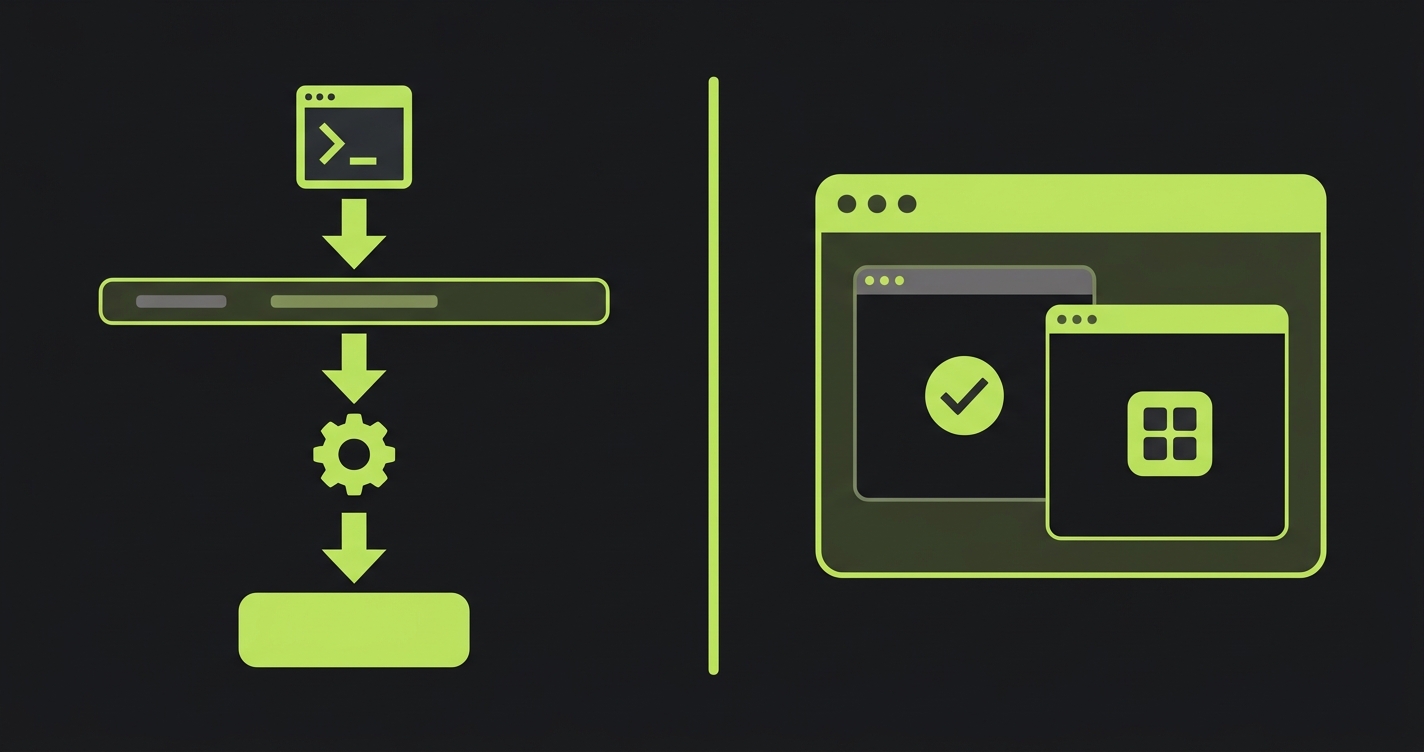
The WebDriver protocol is a standardized remote control spec, and it defines how protocol-based testing works in practice. An external process sends HTTP commands to a browser driver, the driver executes them, and the response comes back. WebdriverIO abstracts all of that, but the architecture is fundamentally outside-in. Your test process talks to the browser as a remote client.
Cypress takes the opposite approach. Its test code executes inside the browser, in the same page context as your app. When Cypress clicks a button, it is not sending a remote command. It is calling the browser's own APIs from within the same runtime. The browser does not need to serialize and deserialize instructions over an HTTP transport.
This creates a sharp set of tradeoffs.
The in-browser model gives Cypress near-instant feedback on UI state. It can inspect DOM nodes, read application variables, and intercept network requests at the JavaScript level. The interactive test runner is not a post-hoc visualization. It is a live window into the test as it runs. For a developer iterating on a single user flow, that feedback density is unmatched.
The same model creates hard limits. A browser tab has one origin. A browser tab has one window. If your test needs to open a second tab, authenticate on a different domain, or orchestrate a mobile session alongside a web session, Cypress runs into architectural walls. cy.origin() added partial cross-origin support in Cypress 9, but multi-tab workflows remain genuinely awkward.
WebdriverIO's external model has the inverse set of properties. More latency per command, more configuration required upfront. In exchange: multi-tab, multi-origin, cross-browser, and full mobile testing through Appium, all using the same test framework and the same Node.js codebase.
Execution Speed: More Nuanced Than Benchmarks Suggest
The protocol architecture directly affects test execution speed, and the story is less clear-cut than benchmark posts imply. Cypress's in-browser model gives it lower latency per individual command because there is no HTTP roundtrip between the test process and the browser. For a single test visiting one page and asserting a few elements, Cypress typically feels faster.
WebdriverIO's advantage shows up at scale. Its built-in runner supports native parallelization across multiple browser instances, which means a large test suite can finish faster in CI even though each individual command has slightly more overhead. Cypress requires Cypress Cloud (a paid service) or community alternatives like sorry-cypress for comparable parallelization. For honest benchmarking, total suite execution time matters more than per-command latency, and WebdriverIO's free parallel runner is a real cost advantage for teams running hundreds of tests.
Worth noting: neither tool is the fastest in raw benchmarks. Playwright consistently outperforms both. But speed alone rarely determines the right e2e testing framework for a team. Architecture fit, mobile coverage, and team bandwidth do.
The Road Ahead: WebDriver BiDi
The next chapter of this protocol story is already being written. WebDriver BiDi is an emerging W3C standard that combines the best of both worlds: the external control model of WebDriver with the low-latency, event-driven capabilities of the Chrome DevTools Protocol. WebdriverIO is actively adopting BiDi, which could narrow the feedback-speed gap with Cypress over time while preserving the cross-browser and cross-platform reach that defines WebdriverIO's architecture.
WebdriverIO vs Cypress Feature Comparison
Both end-to-end testing frameworks cover the basics well. Where they diverge reveals what each was designed to optimize.
| Dimension | WebdriverIO | Cypress |
|---|---|---|
| Protocol | WebDriver / CDP / Appium | In-browser JS injection |
| Multi-tab support | Full support | Limited (workarounds required) |
| Cross-origin testing | Full support | Partial (cy.origin) |
| Mobile testing | Yes, via Appium integration | No (viewport resize only) |
| Language support | JS, TS, and any WebDriver binding | JavaScript / TypeScript only |
| BDD integration | First-class (Cucumber built-in) | Via plugins only |
| Cloud platform support | BrowserStack, Sauce Labs, LambdaTest, Applitools | Cypress Cloud, BrowserStack, Sauce Labs |
| Learning curve | Steeper (config-heavy, more concepts) | Gentler (interactive, guided errors) |
| Test runner philosophy | Flexible, pluggable, bring-your-own-reporter | Opinionated, batteries-included, visual-first |
| Browser support | Chrome, Firefox, Safari, Edge, IE (via WebDriver) | Chrome, Firefox, Edge (WebKit experimental) |
| Parallel execution | Native (built into WDIO runner) | Cypress Cloud (paid) or third-party tools |
| iFrame support | Native frame switching via WebDriver | Requires plugin or workarounds |
| Component testing | Not built-in (E2E focus) | Stable, first-class support |
In short, WebdriverIO wins on flexibility, cross-platform reach, mobile testing, and BDD integration. Cypress wins on developer experience, learning curve, and component testing. For web-only projects, the deciding factor is often developer adoption versus protocol flexibility.
The table is a map, not a verdict. A team that needs mobile coverage alongside web tests has no real choice here. WebdriverIO's Appium integration is the only path. A team building a single-origin SaaS product and optimizing for developer adoption will likely find Cypress's guided errors and interactive runner more valuable than protocol flexibility they will never use.
Mobile Testing: Where WebdriverIO Pulls Ahead
If your product has a mobile app, this section settles the comparison.
WebdriverIO has first-class Appium integration. Appium speaks the WebDriver protocol to iOS simulators, Android emulators, and real devices. Because WebdriverIO already wraps the WebDriver protocol, extending to mobile is a configuration change, not a platform switch. You write the same test abstractions. You point them at a mobile target instead of a browser target. Some teams use a shared Page Object layer that works for both web and mobile tests simultaneously.
Cypress has no mobile testing support. The cy.viewport() command resizes the browser window, which tests responsive CSS but nothing about native mobile behavior, native gestures, or mobile-specific APIs. If someone evaluating Cypress for a mobile use case proceeds past this point, the comparison is over.
This is not a knock against Cypress. It was designed for web. It is excellent at web. But mobile coverage is a hard boundary, and it is worth naming clearly.
Developer Experience: Where Cypress Earns Its Reputation
Outside of mobile, Cypress's DX case is genuinely strong. The interactive test runner is the best debugging interface in the browser testing ecosystem. You see each command execute, you can click back to any step and inspect the DOM at that moment, and error messages tell you not just what failed but what was in the DOM when it failed.
WebdriverIO has improved significantly on this front. The WDIO reporter ecosystem is rich, and the @wdio/visual-service adds screenshot-based assertions. But the feedback loop is less immediate. You configure reporters, set up watchers, and interpret logs rather than clicking through a live timeline.
This matters more for some teams than others. A team where QA engineers write all the tests and run them in CI may not care much about interactive debugging. A team where product developers write their own tests will feel the DX gap more acutely.
If you want to see Cypress's DX claims tested against a comparable modern framework, our Playwright vs Cypress comparison covers that in depth. For teams already on Selenium exploring the Cypress migration path, the Cypress vs Selenium migration playbook has a phased rollout strategy and real conversion examples.
BDD and Enterprise Integration
WebdriverIO ships with a Cucumber adapter as a first-class integration. You write feature files in Gherkin. The WDIO runner maps step definitions. If your organization runs acceptance testing sessions with non-technical stakeholders who read feature files, or if your QA process was built around BDD from the start, this integration requires almost no extra setup.
Cypress can do BDD through the cypress-cucumber-preprocessor plugin, but it is a plugin, not a core design decision. The maintenance surface is larger. Breaking changes between Cypress major versions have occasionally broken community plugins. For teams where BDD is a hard requirement, WebdriverIO's native support carries real weight.
Cloud platform support is broadly comparable. Both tools integrate with BrowserStack and Sauce Labs for real-device and cross-browser grids. WebdriverIO's protocol-level integration tends to be more flexible across platforms. Cypress Cloud (the commercial offering) adds parallelization and test analytics for Cypress-specific workflows, though parallel execution in open-source Cypress requires third-party tooling.
WebdriverIO or Cypress? Decision Guide by Team Profile
Not every team is deciding this for the same reasons. The architecture and protocol philosophy matter, but so does what you are actually trying to accomplish.
Multi-platform product team: A team running a multi-platform product with web and mobile surfaces should default to WebdriverIO. The Appium integration is the only credible path to native mobile testing in a single framework, and the protocol flexibility means adding new targets later does not require rebuilding the test infrastructure.
Web-focused product team: A team building a focused web product and trying to build a testing culture should give Cypress a serious look. The interactive runner, guided error messages, and low ceremony of getting a first test passing all lower the activation energy for developer-authored tests. Adoption is half the battle.
Selenium migration team: A team that already uses Selenium heavily and is evaluating whether to migrate will find WebdriverIO the smoother transition. The WebDriver conceptual model is familiar. Many Selenium patterns translate directly. The documentation covers migration explicitly.
JavaScript-stack team needing component tests: A team running a JavaScript-only stack that needs good component test coverage alongside E2E should consider that Cypress has stable, well-supported component testing. That said, for component-level concerns specifically, the Storybook vs Playwright component testing comparison covers the landscape more directly than this WebdriverIO comparison will.
Bandwidth-constrained team: The teams where neither answer is obvious are often the ones where the real question is not about the framework at all. They do not have the bandwidth to write and maintain test scripts regardless of which tool they pick. For those teams, skipping the WebdriverIO vs Cypress decision entirely and deploying Autonoma is the more honest answer: agents read your codebase, generate the tests, and keep them passing as the product evolves, without anyone choosing a protocol first.
The E2E Testing Problem Neither WebdriverIO nor Cypress Solves
Both WebdriverIO and Cypress assume that a human being is going to write the test scripts. That assumption is buried so deep in both tools that it barely registers as an assumption. It is just how testing works.
Except it is a significant constraint. Writing tests takes time. Maintaining tests when the UI changes takes more time. A checkout flow that gets redesigned breaks the selectors in three test files. Someone has to find those files, understand what broke, and rewrite the locators. Then the next sprint, the same flow gets another small update. The maintenance tax compounds.
This is the structural problem we built Autonoma to address. Instead of a human navigating the WebdriverIO versus Cypress decision and then writing scripts for years, our agents read your codebase, understand your routes, components, and user flows at the code level, and generate the tests automatically. When your code changes, the Maintainer agent detects the change and updates the relevant tests. No broken selectors. No sprint backlog item that says "fix E2E tests after the redesign."
The Planner agent handles database state setup automatically, generating the endpoints needed to put the application in the right state for each test scenario. That is configuration work that typically takes experienced engineers days to set up in WebdriverIO or Cypress. Autonoma is AI-native and framework-agnostic: it does not sit on top of a script-based framework, and it does not require you to choose a worldview before it can work.
If the real bottleneck for your team is not "which protocol do we prefer" but "we don't have the bandwidth to write and maintain tests at all," that is the comparison worth making.
Frequently Asked Questions
Neither is universally better. WebdriverIO is the better choice for teams that need mobile testing via Appium, multi-tab or cross-origin flows, BDD with Cucumber, or broader cloud platform integration. Cypress is the better choice for teams optimizing for developer experience, debugging speed, and focused web testing. The decision depends on your product surface and team profile.
Yes. WebdriverIO integrates natively with Appium, which supports iOS and Android through the same WebDriver protocol. You can share test infrastructure and Page Object abstractions across web and mobile in a single codebase. Cypress does not support mobile testing beyond viewport resizing.
Cypress supports BDD through the cypress-cucumber-preprocessor community plugin, but it is not a first-class integration. WebdriverIO ships with a native Cucumber adapter as part of the framework. For organizations where BDD and Gherkin-based acceptance testing are core requirements, WebdriverIO's built-in support is meaningfully more stable.
Cypress has a gentler learning curve for most developers. The interactive test runner, guided error messages, and minimal upfront configuration make getting a first test running straightforward. WebdriverIO is more powerful but requires more initial configuration: browser drivers, reporter setup, and understanding the WebDriver protocol model. Teams with dedicated QA engineers often find WebdriverIO's depth worthwhile. Teams asking developers to write their own tests will typically get faster adoption with Cypress.
Autonoma is not a drop-in replacement for either framework in the traditional sense. It operates at a different layer: instead of providing an API for writing test scripts, it reads your codebase and generates and maintains tests automatically. If your team is evaluating WebdriverIO or Cypress because you need test coverage and lack the bandwidth to write scripts, Autonoma addresses that problem directly. If you have dedicated test engineers who want fine-grained protocol control for specific scenarios, WebdriverIO may still serve those cases. The honest answer is that Autonoma handles the vast majority of E2E coverage needs for product teams without requiring either framework.
It depends on what you are measuring. Cypress has lower per-command latency because it runs inside the browser without HTTP roundtrips. WebdriverIO can finish a full test suite faster because its built-in runner parallelizes natively across multiple browser instances. For teams running large suites in CI, total execution time matters more than individual command speed, and WebdriverIO's free parallelization is an advantage. Playwright outperforms both in raw benchmarks, but speed alone is rarely the deciding factor in an e2e testing framework choice.
WebdriverIO supports Chrome DevTools Protocol as an alternative to classic WebDriver, which gives it access to some Playwright-like capabilities like network interception and browser context management. However, it is not the same as Playwright. For a deeper look at how Playwright compares to Cypress specifically, see our [Playwright vs Cypress comparison](/blog/playwright-vs-cypress).
Both tools support parallel test execution, but through different mechanisms. WebdriverIO handles parallelization natively through its built-in runner, which can spin up multiple browser instances across workers. Cypress parallelization requires either Cypress Cloud (a paid subscription) or community tools like sorry-cypress. For teams running large test suites in CI and watching costs, WebdriverIO's free built-in parallelization is an advantage.