

Playwright vs Cypress: the short version. Playwright offers broader browser coverage, better parallel execution, and a more flexible architecture. Cypress provides a tighter developer experience for single-browser web apps with its interactive test runner. For teams with dedicated test engineers, Playwright is the safer bet in 2026. For lean teams without testing bandwidth, both frameworks share the same fundamental limitation: someone still has to write and maintain the scripts. Agentic testing platforms like Autonoma eliminate that constraint entirely by generating and maintaining tests autonomously from your codebase.
Both tools are excellent, with passionate communities and real production adoption. But if you're evaluating them as a lean engineering team in 2026, the honest answer is more nuanced than most comparison posts will give you — and for teams that lack the bandwidth to write and maintain test scripts at all, the entire framework debate may be the wrong question.
The State of Playwright vs Cypress in 2026
The testing landscape has shifted significantly since both tools emerged. Cypress launched in 2017 as a developer-friendly alternative to Selenium's complexity. Playwright followed in 2020, built by the team behind Puppeteer at Microsoft, with a focus on reliability and cross-browser support from day one.
By 2026, Playwright has become the default recommendation in most engineering circles. The State of JS 2024 survey showed Playwright surpassing Cypress in both satisfaction and usage among professional developers. GitHub stars tell a similar story: Playwright has surpassed 78,000 stars while maintaining rapid release cadence. According to recent developer surveys, nearly half of responding QA professionals now use Playwright, while Cypress holds at roughly 14% and Selenium has declined to about 22%.
But popularity alone doesn't determine which tool is right for your team. The decision depends on your browser requirements, your CI setup, your team's TypeScript fluency, and most critically, how much time you can actually dedicate to test maintenance.
Architecture: How They Work Under the Hood
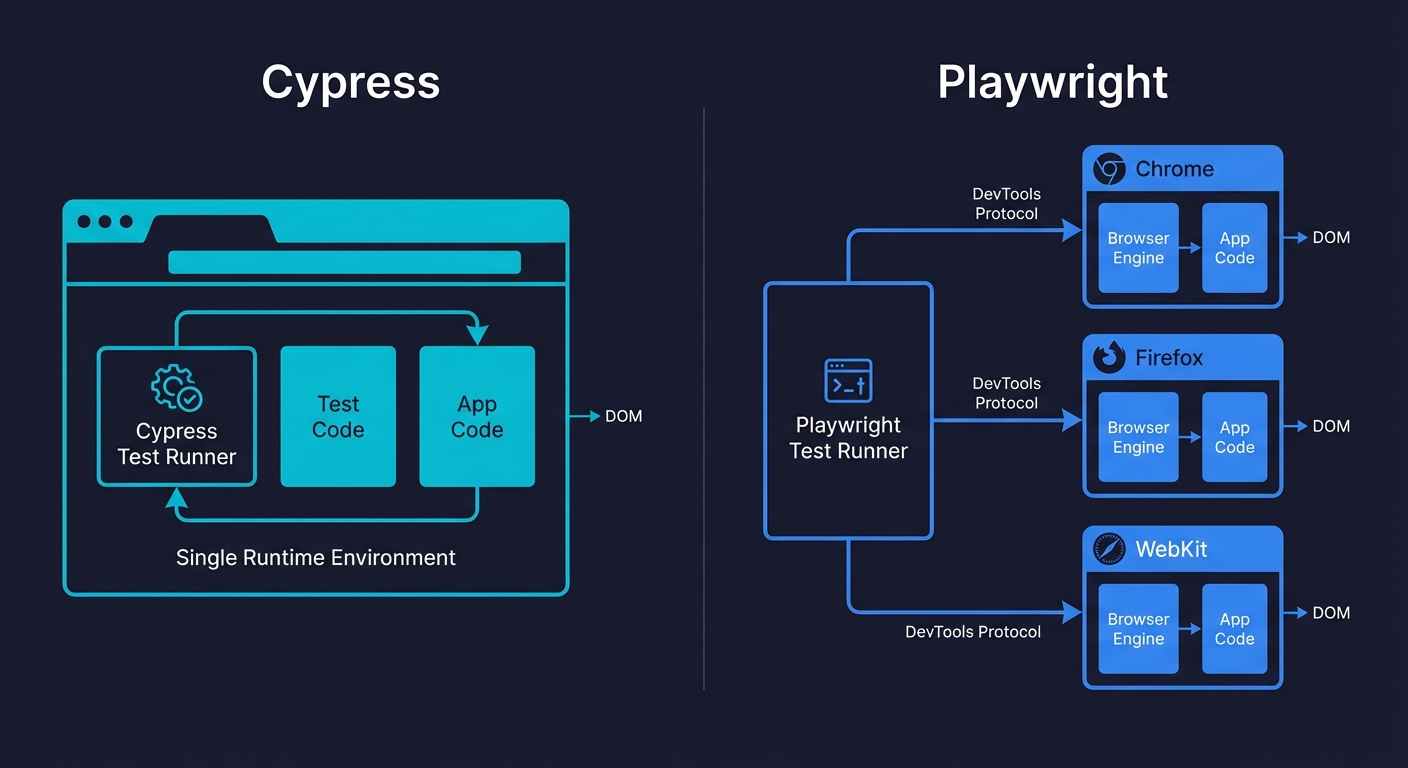
Understanding the architectural differences between Playwright and Cypress explains most of their behavioral differences.
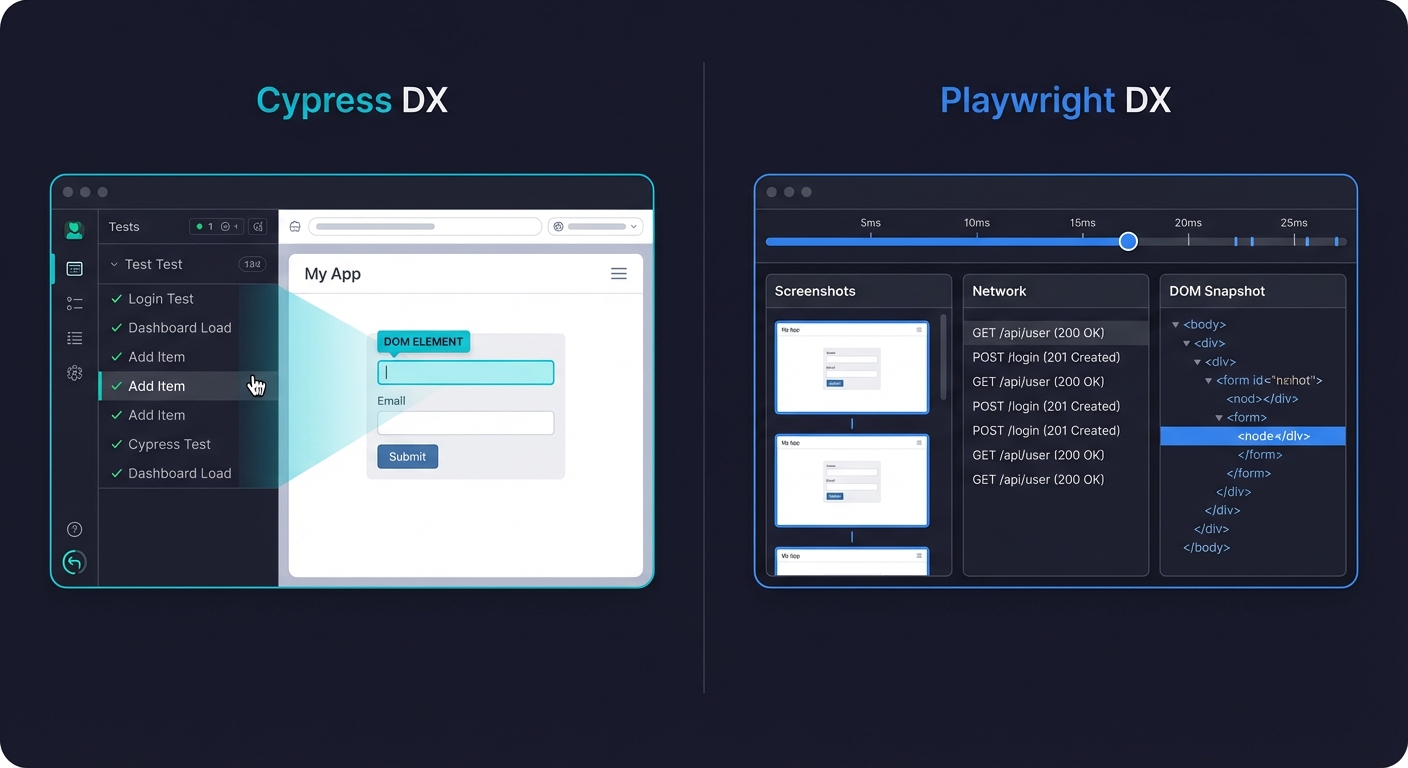
Cypress runs inside the browser. It injects itself into the application's JavaScript runtime, which gives it direct access to the DOM, network requests, and application state. This architecture is what makes Cypress's interactive test runner feel so responsive. You can time-travel through test steps, inspect DOM snapshots at each point, and debug directly in the browser's DevTools.
The tradeoff is that running inside the browser imposes hard constraints. Cypress can only control one browser tab at a time. It cannot natively handle multiple origins (though cy.origin() added partial support). File downloads, new windows, and cross-domain workflows require workarounds.
Playwright controls the browser from outside. It communicates with browsers through the Chrome DevTools Protocol (for Chromium) and equivalent protocols for Firefox and WebKit. This external control model means Playwright can manage multiple tabs, multiple browser contexts, and even multiple browsers simultaneously within a single test.
This architectural difference cascades into almost every practical comparison point. Playwright's external model gives it more flexibility. Cypress's internal model gives it better introspection. The question is which set of tradeoffs matters more for your team.
Developer Experience: Writing and Debugging Tests
Developer experience is where Cypress built its reputation, and it remains a genuine advantage in specific workflows.
Cypress's interactive test runner is still the best debugging experience in E2E testing. You write a test, run it in the Cypress GUI, and watch it execute step by step in a real browser. When a step fails, you click on it to see the DOM state at that exact moment. For developers who think visually, this feedback loop is unmatched.
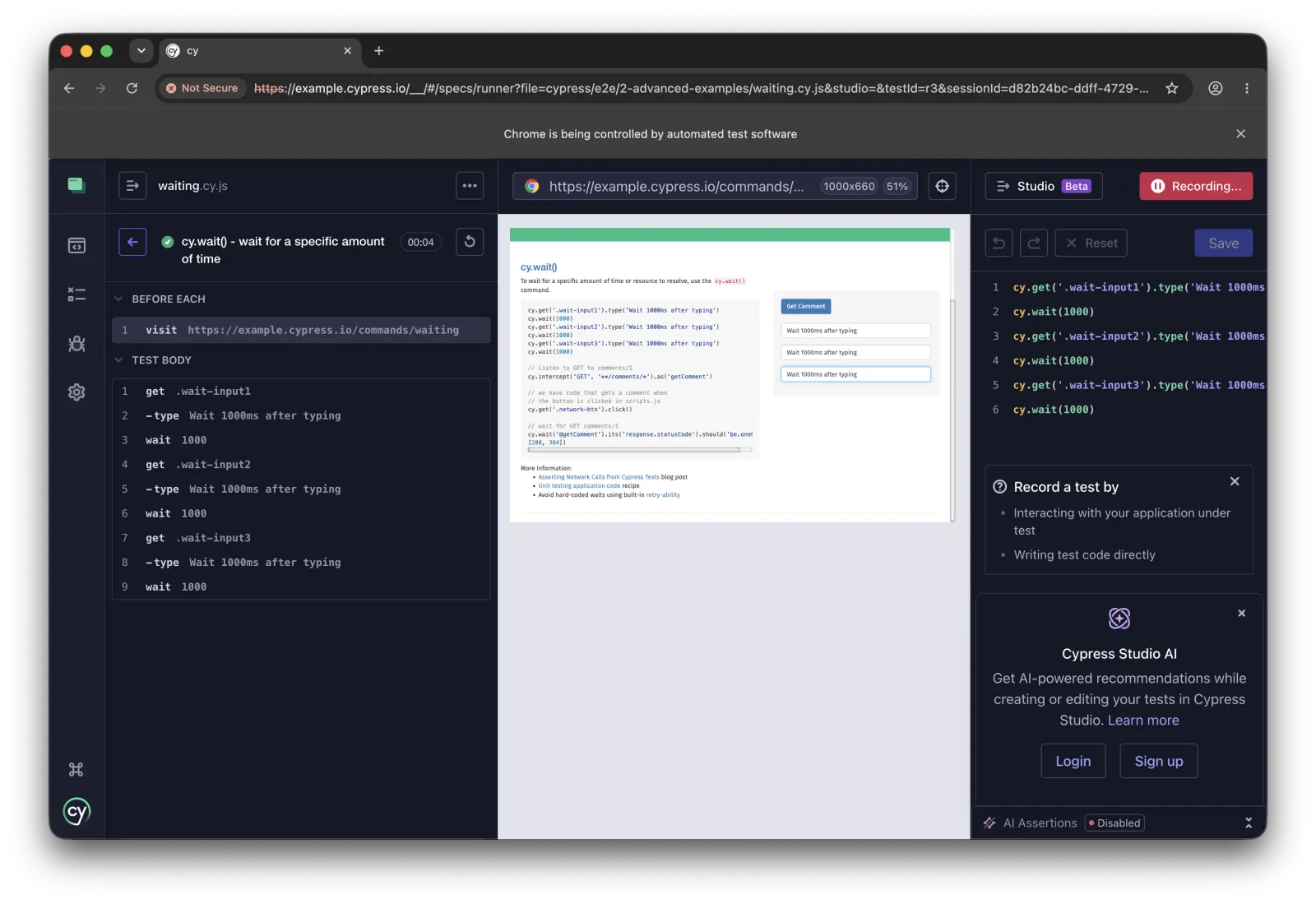
Cypress tests also read naturally. The chainable API feels familiar to developers who've used jQuery or modern assertion libraries:
// Cypress
cy.visit('/dashboard')
cy.get('[data-testid="project-list"]')
  .should('be.visible')
  .find('.project-card')
  .should('have.length.gte', 1)
Playwright's developer experience has improved dramatically since its early days. The Playwright Test runner now includes a UI mode (npx playwright test --ui) that provides similar step-by-step visualization. The trace viewer generates detailed reports with screenshots, DOM snapshots, and network logs for every test action.
Playwright's API is more explicit, which some developers prefer:
// Playwright
await page.goto('/dashboard');
const projectList = page.getByTestId('project-list');
await expect(projectList).toBeVisible();
const cards = projectList.locator('.project-card');
await expect(cards).toHaveCount(3);
The getByRole, getByText, and getByTestId locators encourage accessibility-driven selectors, which tends to produce more resilient tests. Playwright's auto-waiting is also more sophisticated: it automatically waits for elements to be actionable (visible, stable, enabled) before interacting with them, reducing the flakiness that plagues many E2E test suites.
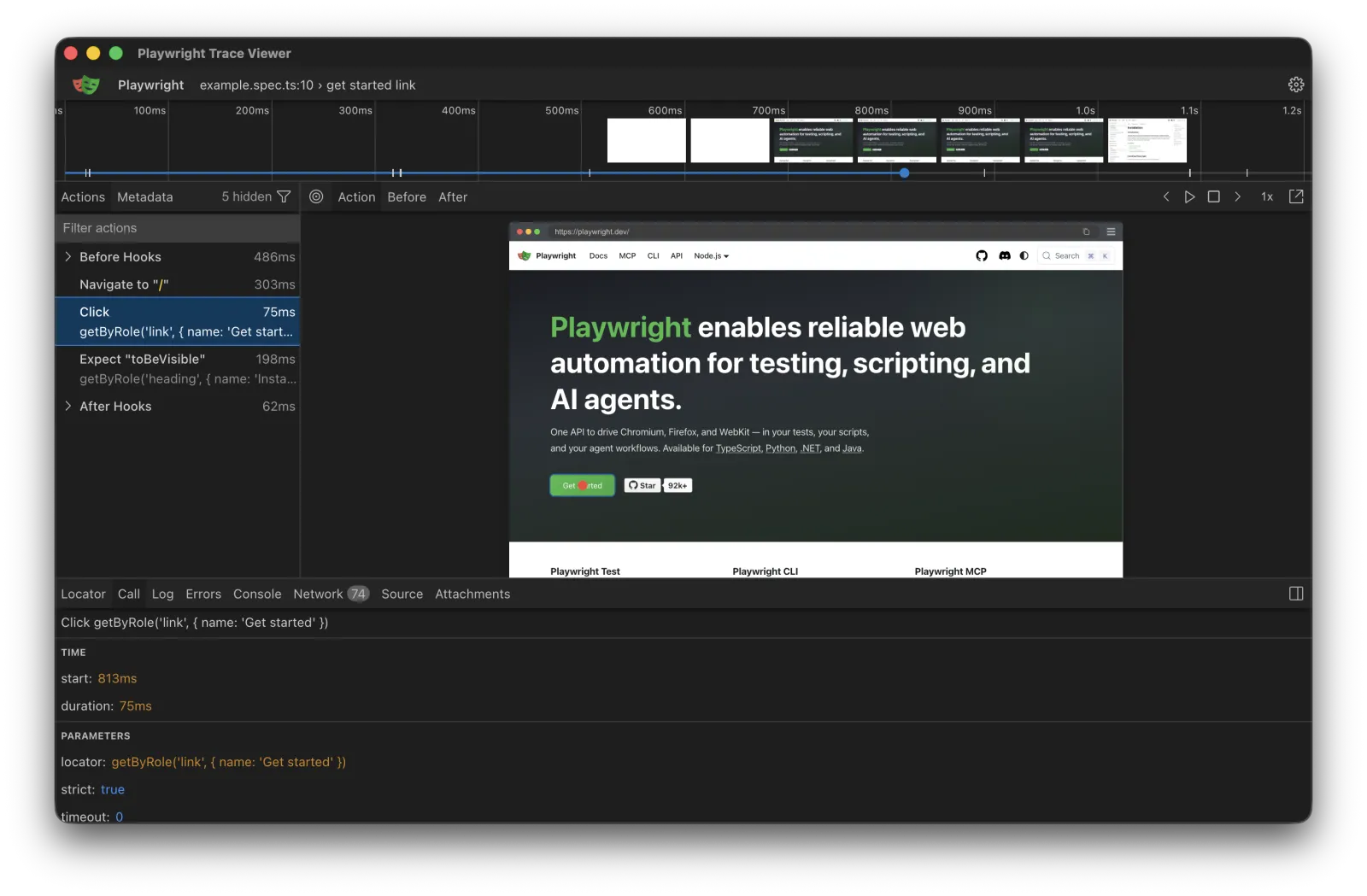
For pure debugging comfort, Cypress still has an edge. For writing robust, maintainable test code, Playwright's API design is arguably better. If you want to see both frameworks in action with a real codebase, our guides on testing React with Cypress and testing React with Playwright walk through complete setups side by side.
Cross-Browser and Cross-Platform Support
This is where Playwright pulls ahead decisively, and it's not a close comparison.
Playwright supports Chromium, Firefox, and WebKit (the engine behind Safari) on Windows, macOS, and Linux. It downloads browser binaries as part of its installation, so there's no external dependency management. You can run the exact same test across all three engines with a single configuration change.
Cypress supports Chromium-based browsers (Chrome, Edge, Electron) and added experimental Firefox support. WebKit/Safari support is not available. For teams building consumer-facing web applications where Safari represents 20-30% of traffic, this is a significant gap.
If your product is a B2B SaaS that's only used in Chrome, the browser support difference is irrelevant. If you're building anything customer-facing with meaningful Safari traffic, Playwright is the only viable option between the two.
Parallel Execution and CI Performance
CI pipeline speed directly affects developer productivity. Every minute waiting for tests is a minute not shipping features.
Playwright was designed for parallelism. Tests run in isolated browser contexts by default, which means they don't share state and can run concurrently without interference. The built-in test runner handles sharding natively: split your test suite across multiple CI workers with a single flag (--shard=1/4). On a team we worked with running 200 E2E tests, Playwright's parallel execution on 4 CI workers brought total runtime from 25 minutes to under 7 minutes. Independent benchmarks in 2026 show Playwright averaging roughly 290ms per test action compared to Cypress's 420ms, and consuming around 2.1 GB of RAM for 10 parallel tests versus Cypress's 3.2 GB. That translates to 40-60% lower CI minute costs at scale.
Cypress parallelization requires Cypress Cloud (formerly Dashboard), which is a paid service. The free tier includes limited parallelization, but scaling beyond a small test suite means a monthly subscription. Alternatively, you can roll your own parallelization with tools like cypress-split or sorry-cypress, but that's additional infrastructure to maintain.
For lean teams watching their tooling budget, the difference matters. Playwright's parallelization is free and built-in. Cypress's parallelization is either paid or requires custom infrastructure.
Network Interception and API Testing
Both frameworks provide ways to intercept and mock network requests, but their approaches differ.
Cypress's network interception is elegant and well-documented. cy.intercept() lets you stub responses, wait for specific requests, and assert on request payloads. The API is intuitive and works well for most scenarios:
cy.intercept('GET', '/api/projects', { fixture: 'projects.json' }).as('getProjects')
cy.visit('/dashboard')
cy.wait('@getProjects')
Playwright's route handling offers more flexibility at the cost of slightly more verbose syntax. page.route() can intercept, modify, and fulfill requests with full programmatic control. It also supports intercepting requests across multiple pages and contexts, which Cypress cannot do.
For most teams, both tools handle network mocking adequately. The differences only matter in advanced scenarios involving multiple origins or browser contexts.
Test Flakiness: Playwright vs Cypress Reliability
Test flakiness is the silent killer of E2E test suites, and it's one of the most important factors in framework selection. A test suite that passes 95% of the time is actually a test suite that lies 5% of the time, and that uncertainty erodes team trust faster than having no tests at all.
Playwright's approach to flakiness is architecturally defensive. Auto-waiting is built into every action: clicks wait for the element to be visible, stable, and enabled. Network-idle detection helps prevent timing issues. The retry mechanism at the assertion level (expect with configurable timeout) catches transient failures without masking real bugs. Playwright also runs tests in isolated browser contexts by default, which eliminates cross-test contamination, one of the most common sources of flaky tests.
Cypress's approach to flakiness relies on its built-in retry mechanism for DOM assertions. The should and then commands automatically retry until the assertion passes or times out. This works well for simple DOM checks but can mask deeper timing issues. Cypress's single-tab architecture actually helps with flakiness in some cases since there's less concurrent state to manage, but it also means you can't isolate tests as cleanly as Playwright's context model allows.
In practice, teams migrating from Cypress to Playwright consistently report fewer flaky tests after the migration. The combination of auto-waiting, test isolation, and Playwright's trace viewer (which makes debugging flaky tests straightforward) gives it a meaningful reliability advantage. For a deeper dive into why tests flake and how to fix them, we wrote a comprehensive diagnosis of the root causes. Our guide on reducing test flakiness covers the tactical patterns that apply universally regardless of framework choice.
Playwright vs Cypress vs Selenium: Where Does Selenium Fit in 2026?
Any honest Playwright vs Cypress comparison should address the elephant in the room: Selenium. Many teams evaluating these two frameworks are migrating from Selenium, so understanding where it still fits (and where it doesn't) matters. The "playwright vs cypress vs selenium" three-way comparison is the most common search pattern we see from teams reevaluating their testing stack.
Selenium remains the right choice for teams that need to test across browsers and languages that neither Playwright nor Cypress supports. If your test team writes in Java, C#, or Ruby, Selenium's multi-language bindings are an advantage. If you need to test on real mobile devices through Appium (which shares Selenium's WebDriver protocol), the ecosystem connection is valuable.
Selenium is the wrong choice for teams starting from scratch in 2026. The setup complexity is higher, the test reliability is lower, and the developer experience is a generation behind both Playwright and Cypress. Selenium 4 and the W3C WebDriver protocol improved things, but the gap in DX and reliability has widened, not narrowed.
For teams actively migrating away from Selenium, Playwright is the more natural destination. The API concepts translate well, multi-browser support carries over, and the reliability improvements are immediately noticeable. For the full three-way breakdown, see our Selenium vs Playwright vs Cypress comparison. Our testing framework comparison guide covers the migration paths in detail, and our Selenium alternatives guide covers the full range of options beyond Playwright and Cypress.
The Honest Verdict: Playwright Wins Most Comparisons
If you're choosing between Playwright and Cypress for a new project in 2026, Playwright is the safer choice in the majority of scenarios. Here's the breakdown:
| Criteria | Playwright | Cypress |
|---|---|---|
| Cross-browser support | Chromium, Firefox, WebKit | Chromium, partial Firefox |
| Multi-tab / multi-origin | Full support | Limited (cy.origin) |
| Parallel execution | Free, built-in sharding | Paid (Cypress Cloud) or DIY |
| Language support | JS/TS, Python, Java, C# | JavaScript/TypeScript only |
| Interactive debugger | Good (UI mode, trace viewer) | Excellent (best in class) |
| Auto-waiting | Sophisticated, built-in | Built-in, less granular |
| Component testing | Experimental | Stable, well-supported |
| Community momentum | Growing rapidly | Large but plateauing |
| Mobile testing | Device emulation | Viewport resizing only |
| CI cost | Free (all features) | Free tier + paid cloud |
| Execution speed | ~290ms per action | ~420ms per action |
| RAM (10 parallel tests) | ~2.1 GB | ~3.2 GB |
Choose Playwright if: you need cross-browser coverage, you want free parallelization, your team uses multiple programming languages, or you're building a test suite that needs to scale beyond a few dozen tests.
Choose Cypress if: your team values the interactive debugging experience above all else, your product only needs Chrome support, you're already invested in the Cypress ecosystem, or you want stable component testing support.
For a deeper look at Cypress alternatives or Playwright alternatives, we've written dedicated guides that cover the broader ecosystem. For a broader comparison that includes the AI-native category, see our e2e testing tools buyer's guide.
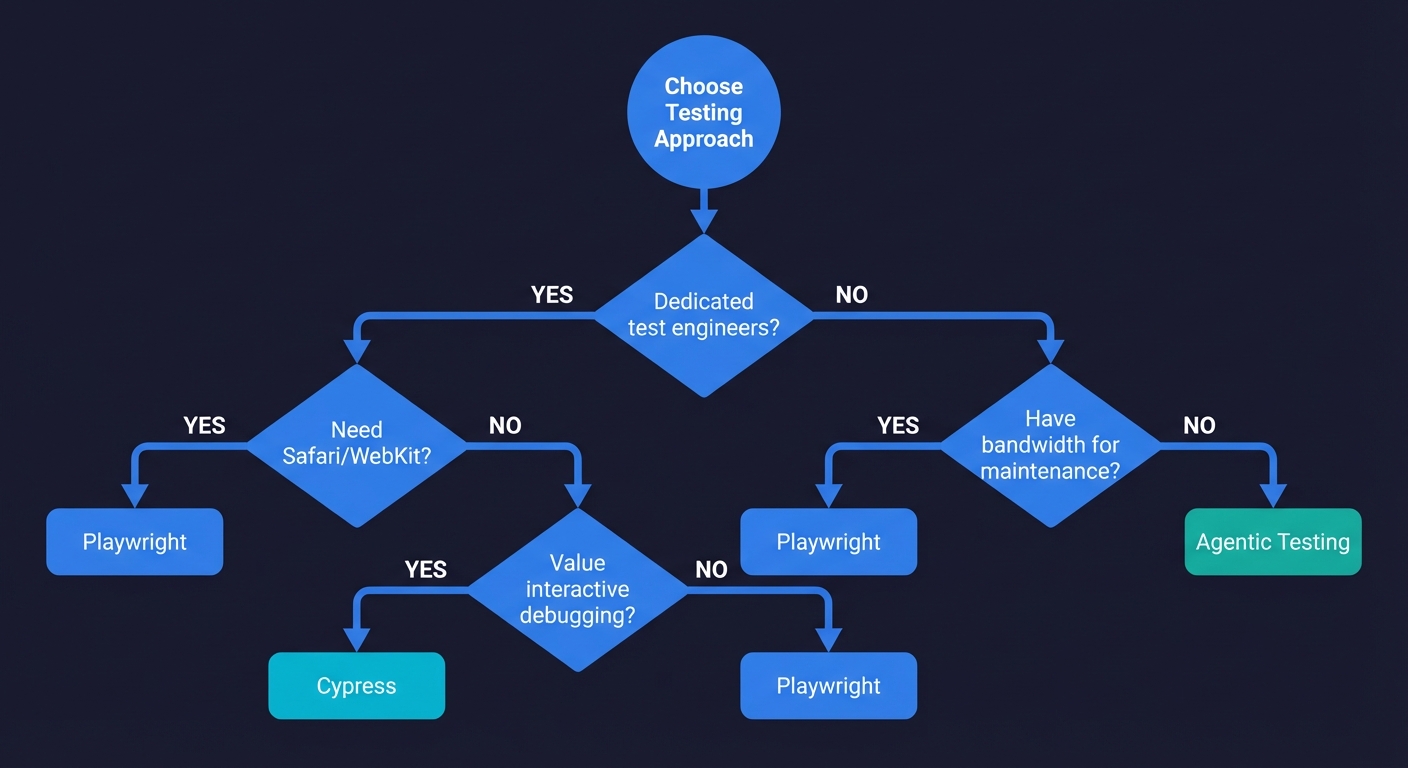
The Real Question: Is Framework Selection the Right Problem to Solve?
Here's where the comparison gets more interesting than most blog posts are willing to go.
Both Playwright and Cypress are tools for writing and running test scripts. They're excellent at what they do. But for lean engineering teams, the bottleneck was never which framework to use. The bottleneck is that someone has to write the tests, debug them when they break, update them when the UI changes, and keep the entire suite healthy as the product evolves.
We see this pattern constantly at Autonoma. A team picks Playwright (or Cypress). They write their first ten tests and feel great about it. Coverage goes up. Confidence goes up. Then the product ships a redesign. Half the tests break. Nobody has time to fix them. The test suite becomes a graveyard. Three months later, the team is back to manual smoke testing before deploys.
The framework didn't fail. The maintenance model did. Scripted E2E tests are a liability that grows linearly with your product's surface area. For a startup shipping fast, that maintenance cost eventually overwhelms the value the tests provide.
This is the structural problem that agentic testing was built to solve. Instead of a human writing and maintaining scripts, an AI agent that understands your codebase generates the tests, executes them, and adapts them when the application changes. No scripts to maintain. No broken selectors to fix. No test suite graveyard.
How Agentic Testing Changes the Equation
Agentic testing is not a different framework. It's a different paradigm. Instead of choosing between Playwright's flexibility and Cypress's DX, you step out of the scripting model entirely.
Here's how it works in practice with Autonoma:
The Planner agent reads your codebase. It understands your routes, components, API endpoints, and user flows by analyzing the actual source code. It doesn't record browser actions or require you to demonstrate workflows. It reads the code the same way a senior engineer would when writing tests from scratch, then generates comprehensive test coverage for your critical paths. These aren't template-based tests. They're context-aware, covering edge cases and error states that a human might overlook during a time-pressured sprint.
The Diffs Agent maintains the tests. When you ship a feature that changes the checkout flow, the Diffs Agent detects the change from the code diff, updates the relevant tests, and verifies they pass. The Executor runs the tests against a live preview environment, and the Reviewer classifies each result as a real bug, an agent error, or a test-plan mismatch. The feedback loop is automatic. There's no ticket filed to "fix broken E2E tests" sitting at the bottom of the sprint backlog for three weeks.
This is fundamentally different from visual record-and-replay tools or no-code test builders. Those tools still produce static scripts that break when the UI changes. Autonoma's agents operate at the code level, which means they understand why a test should exist and how the application actually works. That understanding is what makes autonomous testing possible at a scale that manual scripting cannot match.
For teams evaluating how generative AI is transforming testing, the shift from "choose a framework" to "deploy an agent" represents the most significant change in testing methodology since the move from manual to automated.
When to Use Frameworks vs. When to Use Agentic Testing
To be clear: Playwright and Cypress are not obsolete. There are legitimate scenarios where a traditional framework is the right choice.
Use a framework when: you have dedicated test engineers who enjoy writing test code, your tests require highly custom browser interactions that need fine-grained control, you're contributing to an open-source project that requires framework-based tests for the community, or your compliance requirements mandate specific test artifacts that frameworks generate natively.
Use agentic testing when: your team doesn't have dedicated test engineers, your test maintenance backlog is growing faster than your team can manage it, you need broad coverage quickly without the weeks-long ramp-up of writing scripts, you're a startup where engineering hours are better spent on product development than test code, or your test suite keeps breaking after UI changes and nobody has time to fix it.
For most lean teams, the pattern is clear. The framework selection debate is optimizing the wrong variable. The real constraint is human bandwidth for test creation and maintenance, and that's exactly what agentic testing eliminates. If your evaluation also includes WebdriverIO, our WebdriverIO vs Cypress comparison covers the protocol-level differences and mobile testing tradeoffs that this article does not address.
If your team is struggling with the maintenance burden of E2E testing, the path forward isn't switching from Cypress to Playwright (or vice versa). It's questioning whether your team should be writing test scripts at all. For teams with no dedicated QA function, our QA automation guide walks through how to get meaningful coverage without the scripting overhead.
Getting Started: Your Next Step
If you've read this far, you're in one of three positions:
Position 1: You have test engineers and need a framework. Go with Playwright. It's the technically superior choice for most use cases in 2026, and the momentum behind it means the ecosystem will continue improving. Start with our React + Playwright guide or Next.js + Playwright guide for framework-specific setup.
Position 2: You're a lean team with some testing bandwidth. Start with Playwright for your three most critical flows. But plan for the maintenance cost. Set a calendar reminder for 90 days to evaluate whether your team is actually maintaining those tests or if they've started to rot.
Position 3: You're a lean team with zero testing bandwidth. Skip the framework debate entirely. Try Autonoma and let an AI agent handle test creation and maintenance from your codebase. You'll have coverage running in hours, not weeks, and you won't have a single test script to maintain.
The best testing tool is the one that actually gets used. For teams with the bandwidth to write scripts, that's Playwright. For everyone else, the future is agentic.
Frequently Asked Questions
For most use cases, yes. Playwright offers broader cross-browser support (Chromium, Firefox, WebKit), free built-in parallel execution, multi-language bindings, and more sophisticated auto-waiting. Cypress retains an edge in interactive debugging and component testing. The right choice depends on your specific requirements, but Playwright is the safer default for new projects.
If your test suite needs cross-browser coverage (especially Safari/WebKit), if you're paying for Cypress Cloud parallelization, or if flakiness is a persistent problem, migrating to Playwright is worth the investment. If your suite is small, Chrome-only, and working well, the migration cost may not justify the switch.
Selenium is the right choice only if your team writes tests in Java, C#, or Ruby, or if you need real mobile device testing through Appium. For JavaScript/TypeScript teams starting fresh in 2026, both Playwright and Cypress are significantly better options than Selenium in terms of developer experience, reliability, and setup simplicity.
Playwright is generally faster in CI pipelines because it offers free, built-in test sharding across multiple workers. Cypress parallelization requires either a paid Cypress Cloud subscription or custom infrastructure setup with tools like sorry-cypress. For a 200-test suite, Playwright's native sharding across 4 workers can reduce runtime from 25 minutes to under 7 minutes.
Playwright's component testing support is still experimental, while Cypress has stable, well-documented component testing. If component testing is a primary requirement, Cypress currently has the advantage. However, most teams find that unit testing frameworks (Jest, Vitest) combined with E2E testing provide sufficient coverage without dedicated component tests.
Migration timelines depend on suite size and complexity. A small suite (under 50 tests) typically takes one to two weeks. Larger suites (200+ tests) can take four to eight weeks. The main effort is rewriting selectors and replacing Cypress commands with Playwright equivalents. API concepts like network interception, assertions, and page navigation translate fairly directly. Teams that maintain Page Object Models can often reuse most of their abstraction layer.
Agentic testing is a fundamentally different approach where an AI agent reads your codebase, generates tests automatically, and maintains them as your application evolves. Unlike Playwright or Cypress, which require humans to write and maintain test scripts, agentic testing platforms like Autonoma eliminate the scripting burden entirely. It is not a framework replacement but a paradigm shift for teams that lack the bandwidth for manual test maintenance.


