

Quick summary: Autonoma is the open-source alternative to testRigor for AI-powered testing. testRigor requires you to write tests in proprietary NLP syntax. Autonoma generates tests automatically from your codebase, with no writing required. Autonoma is open source (BSL 1.1), supports self-hosting, uses AI vision for execution and self-healing, and offers transparent pricing with a free tier.
Looking for an open source alternative to testRigor? You're weighing the benefits of AI-powered testing against the risks of proprietary software and vendor lock-in.
testRigor pioneered the "write tests in English" approach. Tests become readable by anyone on your team, not just engineers fluent in Selenium or Playwright syntax. The promise is compelling: no coding, faster test creation, AI-powered self-healing. But testRigor is completely proprietary. You can't inspect the code, you can't self-host, you can't extend it for your specific needs, and you're locked into their pricing model. When you invest thousands of hours creating tests in testRigor's format, you've built your entire QA operation on a platform you don't control. (For context on why this matters, see our State of QA 2025 research.)
Autonoma takes a fundamentally different approach. Instead of asking you to write tests in natural language, Autonoma's AI generates tests directly from your codebase. Connect your GitHub repo, and AI agents analyze your routes, components, and user flows to produce comprehensive E2E tests automatically. The code is open source, you can self-host on your own infrastructure, and your tests are never locked into a proprietary format.
Why Teams Choose Open Source Over testRigor
The shift from proprietary testing to open source comes down to three things: vendor lock-in risk, deployment control, and transparency.
Every test you write in testRigor exists in their proprietary format with no export path. There's no migration to Playwright, no conversion to Cypress, no fallback option. If testRigor raises prices 3x next year, gets acquired and changes direction, or shuts down entirely, your QA operation is at risk. You're completely dependent on their business decisions.
With Autonoma, you have the source code. If our cloud service doesn't meet your needs, deploy on your own infrastructure. If you want to add custom features, fork the repository. If we disappeared tomorrow, the software keeps running; the community can maintain and improve it. Since tests are generated from your codebase, they're tied to your application logic, not a vendor's format.
Self-hosting matters for both compliance and cost. Financial services, healthcare, and government teams often cannot send production data or credentials to third-party clouds. testRigor operates exclusively in the cloud: every test execution runs on their infrastructure, making it unusable for regulated environments. Autonoma runs on your Kubernetes cluster, AWS infrastructure, or on-premises servers behind your firewall. You control the data, you control the costs, and there are no per-execution fees once your infrastructure is set up.
Open source also means transparency when things go wrong. When a testRigor test fails, you're debugging a black box: you can see the failure, but you can't see how testRigor interpreted your natural language command, which element it targeted, or why it chose that element. With Autonoma, you can trace through the code to understand exactly what happened. When you need custom behavior, you modify the source. When you find a bug, you can verify the fix yourself rather than waiting on a vendor's timeline. This transparency builds trust with your engineering team: they're not hoping a proprietary vendor fixed an issue, they can confirm it themselves.
Every team also has unique requirements. Maybe you need specific database setup steps before tests. Maybe you need custom reporting formats. Maybe you need integration with internal tools that no vendor supports. Proprietary software forces you to work within the vendor's feature set and wait for their roadmap. Open source lets you fork, modify, and run a customized version that fits your exact needs.
How testRigor and Autonoma Compare
Both platforms share a core philosophy: testing should be accessible to anyone, not just engineers who can write code. But they deliver on that promise in fundamentally different ways.
Testing Approach: Writing vs Generation
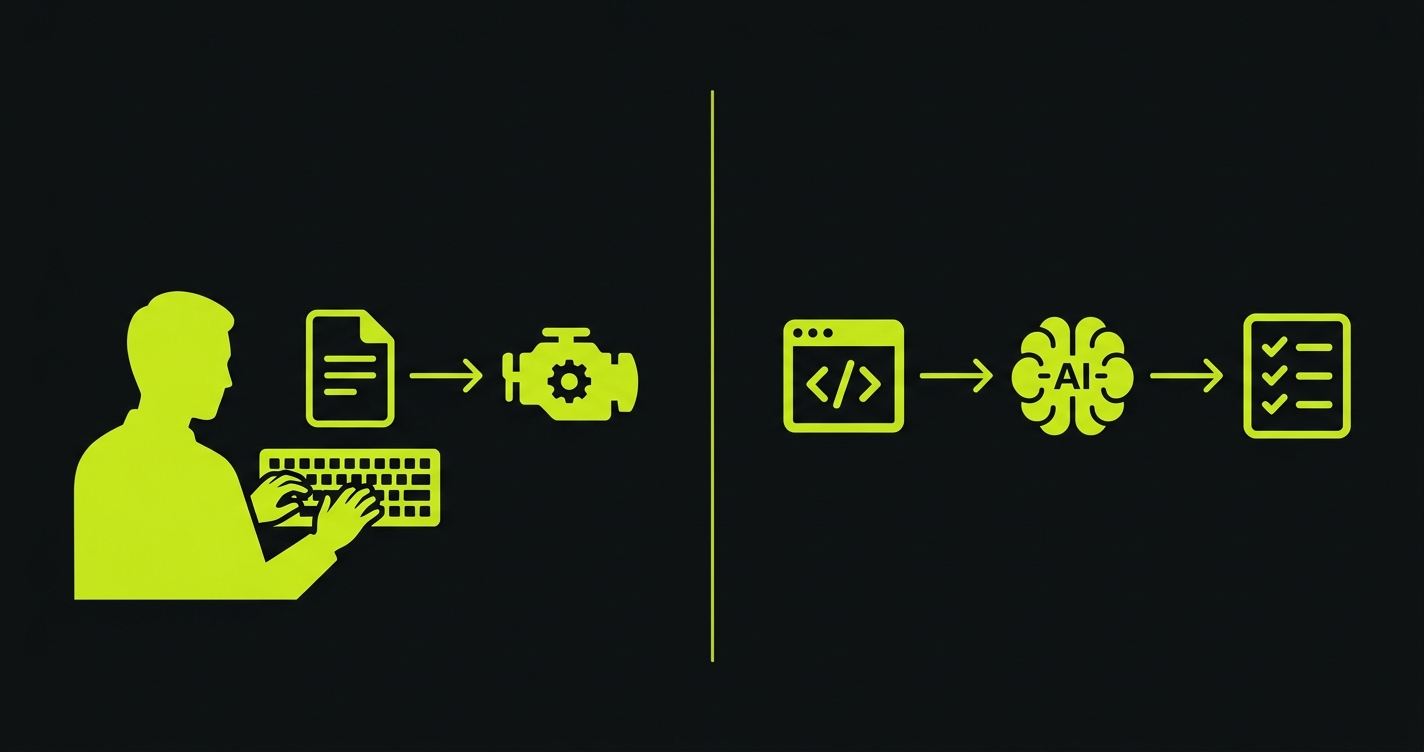
The core difference: testRigor still requires you to write every test. Autonoma generates them from your codebase.
testRigor's approach: Rule-based NLP parsing. You write commands like "click button with text 'Submit'" and testRigor's engine parses the English, applies predefined rules to locate elements, and executes the action. The language is more accessible than Selenium or Playwright, but the authoring burden is the same: someone still writes every test case, specifies every assertion, and maintains every script when the application changes.
Autonoma's approach: Codebase-first AI generation. Connect your GitHub repo, and Autonoma's AI agents analyze your routes, components, and user flows. They automatically generate comprehensive E2E test cases covering happy paths, error states, and edge cases. During execution, vision models see your application like a human would: no CSS selectors, no XPaths, no brittle element identifiers. When your UI changes, the AI adapts because it understands the intent of each test, not just which elements to click.
At scale, this difference is decisive. With testRigor, 500 test scenarios means someone writes 500 tests and maintains them as the application evolves. Every new feature requires new test scripts. Every refactor risks breaking existing ones. With Autonoma, AI generates tests from your code and keeps them synchronized automatically. When you ship a new feature, the AI detects new routes and components and generates coverage for them. Your QA team focuses on reviewing coverage and validating results rather than authoring and maintaining scripts.
This also changes who can participate in testing. testRigor lowered the bar from "write Selenium code" to "write English commands," but someone still needs to understand the application well enough to specify each test. Autonoma removes that bottleneck entirely: the AI reads your codebase and produces tests that cover flows a human might not think to test.
Cross-Platform: Web and Mobile
Both platforms support web and mobile testing across iOS and Android. testRigor provides device cloud access for running tests on real devices: you write tests in its natural language format, and testRigor executes them against your chosen device configurations.
Autonoma integrates with Playwright for web testing and Appium for mobile testing. Tests are generated from your codebase and executed across browsers, emulators, and real devices. The same AI vision capabilities work consistently across all platforms. The key architectural difference: Autonoma builds on proven open source testing frameworks (Playwright, Appium) that have large communities and extensive documentation, while testRigor maintains proprietary execution engines.
Self-Healing: How Each Platform Adapts to Change
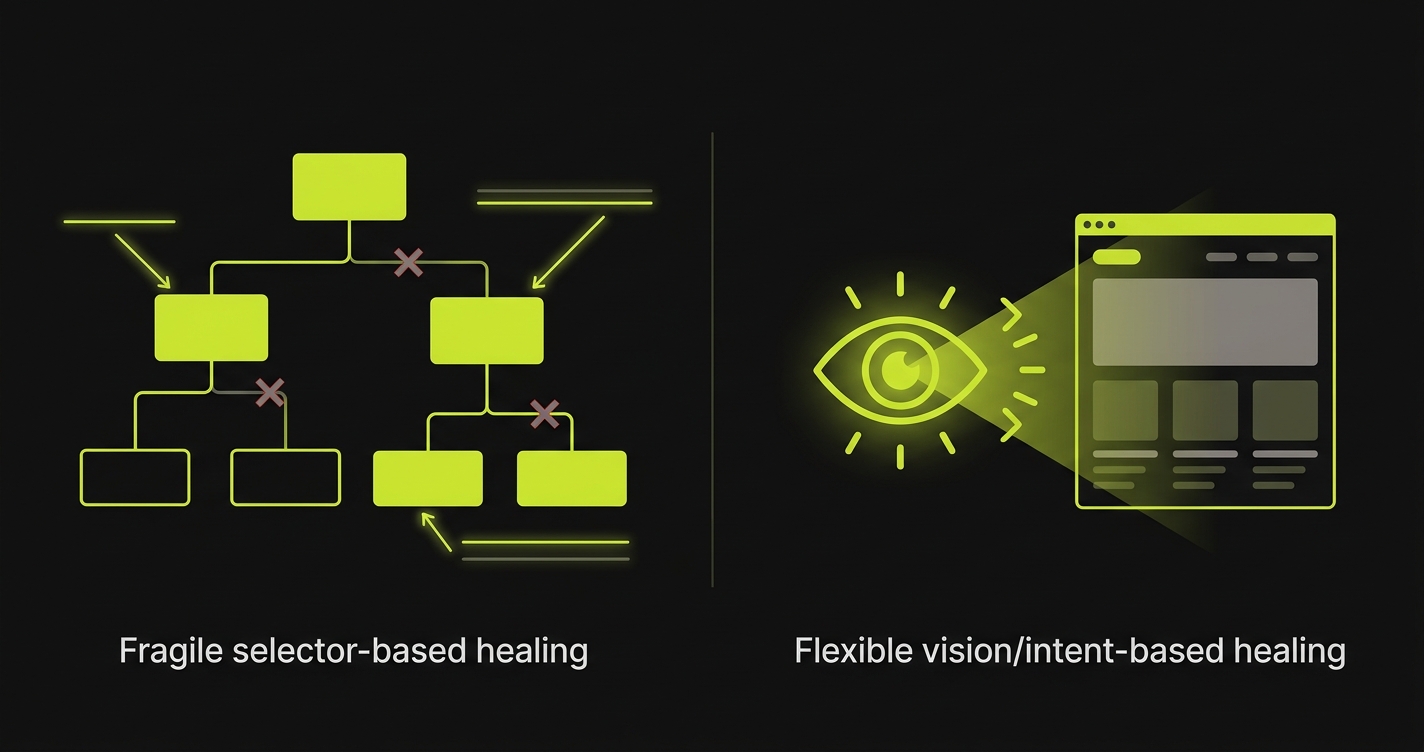
Both platforms promise AI-powered self-healing to reduce test maintenance, but the mechanisms differ in important ways.
testRigor's self-healing handles element-level changes well. If your button's CSS class changes from btn-submit to submit-button, testRigor recognizes it's the same button and adapts. But when workflows change (when your three-step checkout becomes a two-step checkout, when forms are reorganized, when entirely new screens are introduced), selector-based healing hits its limits. The structure testRigor relied on no longer exists.
Autonoma's self-healing works at the intent level. Because tests are generated from your codebase, the AI understands what each test is trying to accomplish, not just which elements to interact with. It uses vision models to see the application like a user would. When your code changes, whether that's a minor button rename or a major checkout redesign, the AI re-analyzes your codebase and adapts test execution to match the new reality. This makes Autonoma's self-healing effective across both minor UI tweaks and major architectural shifts. The result is dramatically less test maintenance: instead of spending hours per sprint fixing broken tests after a redesign, the AI handles adaptation automatically.
Pricing: Transparent vs Enterprise-Only
testRigor uses enterprise sales-driven pricing. You contact their sales team for a quote based on your team size, usage volume, and feature requirements. Published information suggests pricing starts at several thousand dollars per month with per-user licensing and execution limits.
Autonoma uses transparent, published pricing:
- Free tier: 100,000 credits (approximately 1,000-2,000 test executions), no credit card required
- Paid plans: Starting at $499/month for 1 million credits, unlimited users, unlimited parallel execution
- Self-hosted: Infrastructure cost only: no software licensing fees, no per-execution charges
You can calculate your costs before committing. There are no surprise charges for additional users, premium features, or expanded usage. For self-hosted deployments, the open source model means you pay only for your own infrastructure: no software licensing fees regardless of how many tests you run or how many team members access the platform.
Detailed Feature Comparison
| Feature | testRigor | Autonoma |
|---|---|---|
| Source Code | Proprietary, closed source | Open source (GitHub, BSL 1.1) |
| Test Creation | You write tests in NLP syntax | AI generates tests from your codebase |
| Self-Healing | ✅ Selector-based | ✅ Intent-based |
| Web Testing | ✅ Chrome, Firefox, Safari, Edge | ✅ Chrome, Firefox, Safari (Playwright) |
| Mobile Testing | ✅ iOS, Android (real devices) | ✅ iOS, Android (emulators + real devices) |
| Desktop Testing | ✅ Windows, macOS | Coming soon |
| Self-Hosting | ❌ Cloud only | ✅ Full self-hosting support |
| Deployment Options | Cloud only | Cloud, Kubernetes, AWS, on-premises |
| Data Control | Data stored on testRigor servers | Full data control (self-host or cloud) |
| API Access | ✅ REST API | ✅ REST API + GitHub App integration |
| CI/CD Integration | ✅ Major platforms | ✅ GitHub Actions, Jenkins, CircleCI, etc. |
| Parallel Execution | Limited by plan | Unlimited |
| Element Detection | Rule-based parsing | AI computer vision |
| Test Export | ❌ Proprietary format only | ✅ Tests generated from code (no lock-in) |
| Code Inspection | ❌ Closed source | ✅ Full source code access |
| Custom Extensions | ❌ Not possible | ✅ Fork and modify |
| Pricing Model | Enterprise sales (contact required) | Transparent (free tier + paid plans) |
| Free Tier | Trial only | ✅ 100K credits, no credit card |
| Community | Support forum | GitHub community + support forum |
Real-World Example: Checkout Flow Testing
Consider an e-commerce checkout that your design team A/B tests constantly, sometimes five steps, sometimes three, with shifting button text and form layouts. In testRigor, you manually write tests referencing specific buttons and form fields like "click 'Continue to Payment'" and "type into 'card_number'." When the design combines shipping and payment into one step, tests break because "Continue to Payment" no longer exists. Selector-based healing can't fix workflow changes, only element-level changes. You rewrite the test. Two weeks later, the flow reverts to five steps for different user segments, and you're maintaining multiple test variations.
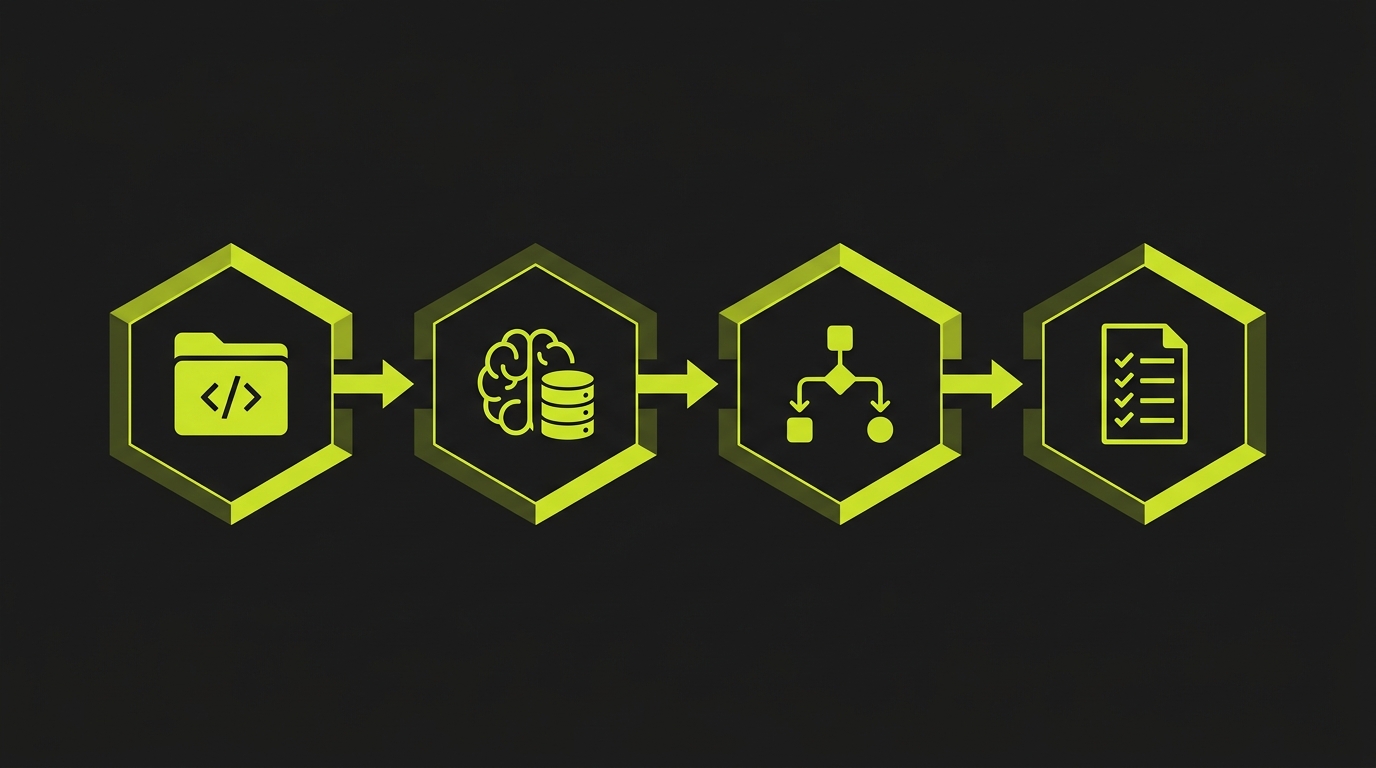
With Autonoma, you don't write the test at all. The test-planner-plugin reads your codebase: the planner agent identifies checkout routes, form components, and payment integration, then generates scenarios covering successful purchases, failed payments, and edge cases. It sets up test data and hands off to the automator agent, which executes using vision models that see the UI like a human. When your design combines steps, the AI re-analyzes the code and adapts. When the flow reverts for different segments, it adapts again. Tests stay synchronized because they're derived from code, not manually scripted against a specific UI state.
This is the fundamental difference: testRigor makes test writing easier. Autonoma eliminates test writing entirely. And as applications grow more complex (with feature flags, personalization, and multi-variant A/B tests), the gap between these approaches widens. Manually maintaining test scripts for every variant doesn't scale. Generating tests from code does.
Migration from testRigor
If you've already built a test suite in testRigor, migration doesn't mean porting scripts line by line; that would defeat the purpose. Start by inventorying your existing testRigor tests: which are active, which cover critical paths, and which testRigor-specific features you rely on. This gives you a baseline to validate against.
Then connect your GitHub repo via Autonoma's GitHub App, and AI agents analyze your codebase to generate fresh test coverage automatically. You're not rewriting testRigor scripts; the AI produces new coverage from your code. Review the generated test plans to verify they match or exceed your existing suite's coverage. Teams often find that Autonoma catches scenarios their manually-written tests missed, since the AI analyzes code paths exhaustively rather than relying on what a human thought to test.
Replace testRigor API calls in your CI/CD pipeline with Autonoma API calls; this typically takes two to four hours. Run both platforms in parallel for one to four weeks to build confidence before completing the cutover and canceling your testRigor subscription.
For a typical suite of 50-100 tests, expect about one week for small suites (under 30 tests), two to three weeks for medium suites (50-100 tests), and four to six weeks for large suites (200+ tests). These timelines reflect validation and CI/CD integration, not manual test porting; the effort is verifying coverage, not rewriting.
Get Started
Sign up at getautonoma.com: no credit card required, 100,000 free credits to start. Install the GitHub App, grant access to your repository, and AI agents analyze your codebase and generate E2E test cases within minutes. Run them against your staging environment and review the results.
From there, add Autonoma to your CI/CD pipeline using the GitHub Actions integration. Configure test triggers on pull requests or deployments, set up result notifications to your team's Slack or email, and you're running automated E2E tests on every change. As your codebase grows, AI agents automatically expand coverage to match new features, and self-healing keeps existing tests synchronized with your evolving application.
For teams that need full control, self-host on your own infrastructure using the open source repo. Clone the repository, configure your environment, deploy to Kubernetes, and run the full platform behind your firewall. Deployment documentation and Kubernetes manifests are available in the GitHub repository. For teams without Kubernetes expertise, the managed cloud offering provides the same functionality without infrastructure management.
Frequently Asked Questions
Yes. Autonoma's core testing engine is available on GitHub at github.com/autonoma-ai/autonoma under BSL 1.1 (Business Source License), which converts to Apache 2.0 in March 2028. You can inspect the code, contribute improvements, self-host the entire platform, and modify it to fit your needs. The only restriction is you can't resell it as a commercial service. There are no feature restrictions in the open source version.
testRigor requires you to write tests in its NLP syntax; you still author every test manually. Autonoma generates tests automatically from your codebase. AI agents analyze your routes, components, and user flows, then create comprehensive E2E test cases without any manual writing. During execution, Autonoma uses AI vision models to interact with your app like a human would, while testRigor relies on rule-based element identification.
Yes. Deploy on your own Kubernetes cluster, AWS infrastructure, or on-premises servers with no feature limits. All cloud features work identically in self-hosted deployments. This gives you complete data control, eliminates per-test execution costs, and removes vendor dependency.
testRigor requires manual test writing (in NLP syntax), Autonoma generates tests from code automatically. testRigor is proprietary and closed-source, Autonoma is open source (BSL 1.1). testRigor is cloud-only, Autonoma supports cloud and self-hosted. testRigor has enterprise pricing, Autonoma has a free tier and transparent pricing. testRigor locks you into their platform, Autonoma gives you the code.
You don't migrate tests one-by-one. Connect your repo and Autonoma's AI generates tests from your codebase; you're replacing testRigor scripts with AI-generated coverage. The migration effort is validating that generated tests cover the same scenarios. Most teams achieve full coverage within days.
The Bottom Line
testRigor proved that writing tests in English instead of code lowers the barrier for non-engineers. That was a real advance. But the question has moved beyond "how do we write tests more easily?" The real question is: why are we still writing tests at all?
Autonoma eliminates test writing entirely. AI generates tests from your codebase, executes them with vision models, and maintains them automatically. You get automatic test generation from your codebase with no writing required, full source code on GitHub under BSL 1.1 (converting to Apache 2.0 in March 2028), self-hosting options for compliance and cost control, intent-based AI vision that adapts to both UI tweaks and major workflow redesigns, transparent pricing with a generous free tier, and zero vendor lock-in.
Choose open source when you want control, transparency, and long-term flexibility in your testing infrastructure.
Ready to try the open source alternative?
Start Free on Autonoma - 100K credits, no credit card, full platform access
View the Source Code - Fork, modify, contribute
Read the Documentation - Self-hosting guides, API reference, tutorials
Related Reading: