

Quick summary: Autonoma is the open-source alternative to BrowserStack. Unlike BrowserStack's proprietary platform ($150-375/month, limited parallels), Autonoma generates tests automatically from your codebase using AI agents. Full source code on GitHub (BSL 1.1), self-hosting, vision-based self-healing, unlimited parallel execution, no vendor lock-in. Free tier: 100K credits. Cloud: $499/month. Self-hosted: no ongoing costs.
BrowserStack dominates the cross-browser testing market, but its model has real limitations. It costs $150-375 per month for teams. Tests run exclusively on their cloud. You are locked into their proprietary platform with no self-hosting option and no source code access. Your test data, application credentials, and execution logs all live on their servers.
For teams that need infrastructure control, data sovereignty for compliance, or cost predictability as they scale, this model breaks down fast. And for teams tired of spending engineering hours maintaining brittle selector-based tests, the problem goes deeper than infrastructure.
Autonoma is the open-source alternative built for these teams. Full source code on GitHub, self-hosting on your infrastructure or our cloud, AI that generates and maintains tests automatically from your codebase, unlimited parallel execution, and zero vendor lock-in. This guide covers where BrowserStack falls short, how Autonoma solves those problems, and how to get started. (For a broader comparison, see our BrowserStack alternatives roundup.)
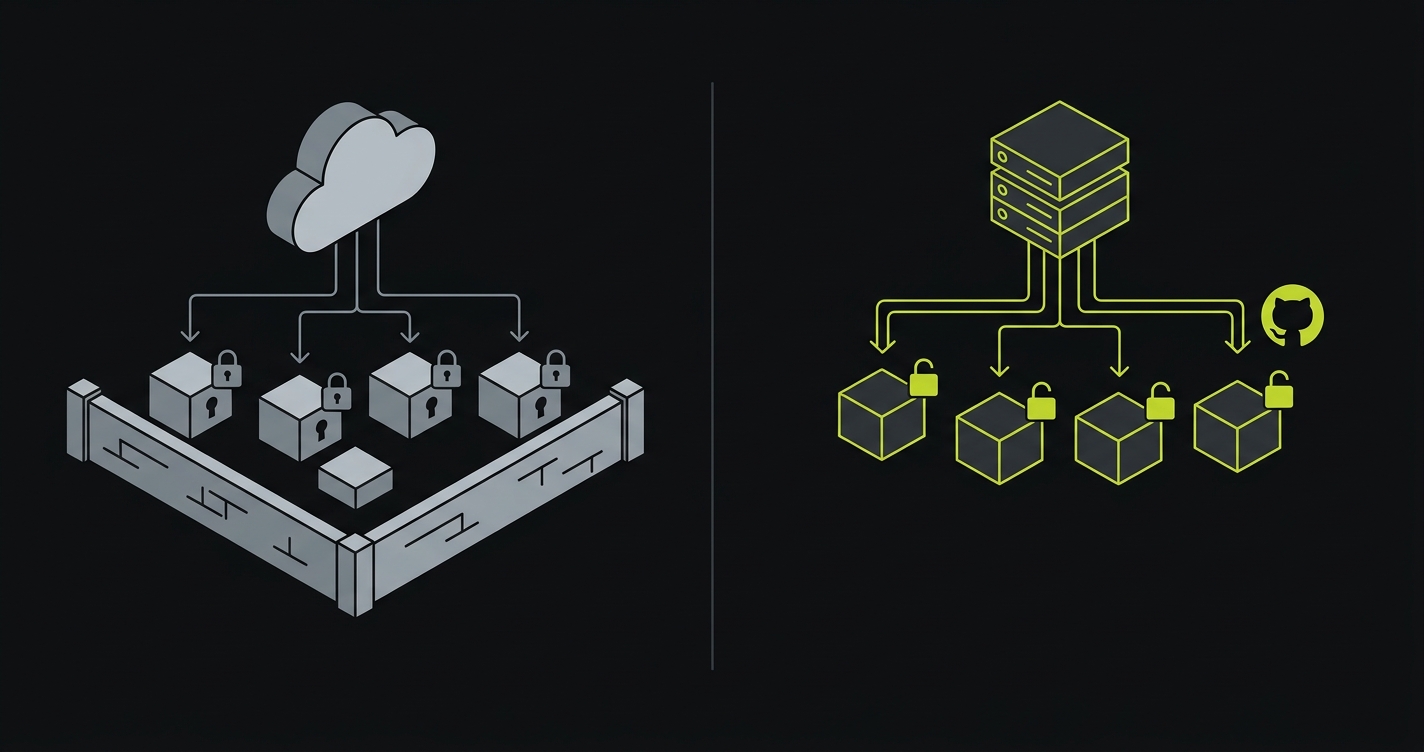
Where BrowserStack Falls Short
Three core problems drive engineering teams toward open source alternatives.
No Transparency, No Self-Hosting
BrowserStack is closed source. You cannot inspect how tests execute, audit security practices, or customize behavior. When something breaks in their infrastructure, you file a support ticket and wait. There is no way to debug the platform itself, reproduce issues locally, or verify that their environment matches your production setup.
More critically, your test data, application data, and credentials all pass through BrowserStack's infrastructure with no self-hosting option. Every test run sends your application URLs, login credentials, and potentially sensitive user data to their servers. For teams building healthcare applications, financial platforms, or government systems, this is often a dealbreaker. HIPAA, PCI DSS, SOC 2, and FedRAMP compliance frameworks frequently require that testing infrastructure runs on controlled, auditable environments.
One security team told us: "We needed to audit the testing infrastructure for SOC 2 compliance. BrowserStack couldn't provide source code for review. That ended the conversation."
Even teams without strict compliance requirements increasingly prefer control over where their data lives. The trend toward data sovereignty is accelerating, and BrowserStack's cloud-only model cannot accommodate it.
Parallel Execution Limits and Cost Scaling
BrowserStack's team plans include "unlimited testing minutes" but cap parallel execution at 3-5 concurrent tests depending on tier. You can run tests all day, but only a handful at a time. For teams with growing test suites, this creates painful bottlenecks.
Consider a team with 500 E2E tests averaging 1 minute each. At 5 parallels, the full suite takes roughly 100 minutes. They need 25 parallels to get that down to 20 minutes, but BrowserStack's parallel limits are tied to pricing tiers. Increasing parallels means moving to enterprise pricing, negotiating contracts, and paying significantly more.
Plans range from $150/month (Team, limited parallels) to $249/month (Team Pro) to $375/month (Team Ultimate, 3-5 users). For a team of 10-15 running continuous testing, annual costs reach $2,500-4,500 before you hit the parallel wall. Scaling always means paying more, and the per-parallel cost structure creates an artificial ceiling on how fast your test suite can run.
Manual Test Maintenance and Vendor Lock-In
BrowserStack executes tests you write. It does not write them for you, and it does not maintain them. When your designer updates a button class, your CSS selectors break. When a developer restructures a form, XPath locators fail. When your team ships a new checkout flow, someone has to rewrite the test. Every sprint, QA engineers spend hours fixing broken tests that have nothing to do with actual bugs.
One QA manager told us: "We're paying BrowserStack $3,000 annually to run tests, then paying engineers $20,000 annually to maintain them. The maintenance costs more than the tool."
On top of the maintenance burden, BrowserStack creates significant vendor lock-in. Tests are stored in their system. CI/CD integrations are built around their API and runner configuration. If you decide to switch platforms, you are rewriting everything from scratch. One team we spoke with spent 6 months migrating off BrowserStack: rewriting 300+ tests, rebuilding CI integrations, and retraining their entire QA team. That migration cost more than two years of BrowserStack subscription fees.
Autonoma: The Open Source Alternative to BrowserStack
Autonoma is an open-source, AI-native testing platform built to solve the problems above.
Open Source and Self-Hosting
Full source code on GitHub. Licensed under BSL 1.1 (converts to Apache 2.0 in 2028). You can use it in production, inspect every line, audit security, and self-host with no feature restrictions. The only limitation: you can't resell Autonoma's functionality as a commercial service.
This transparency directly solves the compliance problem. Need to audit testing infrastructure for HIPAA, PCI DSS, or SOC 2? Read the source code. Need to verify how credentials are handled during test execution? Inspect the runtime. Need to customize test execution behavior for your environment? Fork and modify. None of this is possible with BrowserStack.
Run Autonoma on your infrastructure. AWS (ECS, EKS, or EC2), GCP (GKE or Compute Engine), Azure (AKS or VMs), or your own data center. When you self-host, your data never leaves your infrastructure. Tests run in your VPC. Credentials stay on your servers. Application URLs are never exposed to external systems.
The technology stack is built on standard open source components you already know: TypeScript and Node.js 24 for the runtime, Playwright for web testing, Appium for mobile testing, PostgreSQL for data storage, and Kubernetes for orchestration. No proprietary runtimes, no black-box components, no vendor-specific dependencies.
Self-hosting is free: no platform fees, no per-user charges, no per-parallel markup. You pay only for the cloud infrastructure you provision. For teams with existing cloud infrastructure, this costs 60-80% less than BrowserStack.
AI-Powered Autonomous Testing
Unlike BrowserStack where you write and maintain tests manually, Autonoma generates tests automatically from your codebase.
How it works: You connect your GitHub repo, and Autonoma's test-planner-plugin reads your routes, components, and user flows to build a knowledge base of your application. AI agents then generate comprehensive E2E test cases based on your actual code structure, with no manual test writing required. Tests execute using AI vision models that see your app like a human would, which means no CSS selectors or XPaths to break. When your UI changes, tests adapt automatically because the AI understands intent, not DOM structure. Each step includes verification layers to ensure consistent, reliable behavior.
You don't write tests. You don't maintain selectors. You don't update test scripts when features change. The AI handles the entire testing lifecycle, from understanding your codebase to generating, executing, and maintaining tests.
This is the fundamental difference from BrowserStack. BrowserStack is a test execution platform: it runs tests you write and maintain. Autonoma is an autonomous testing system: it generates, executes, and maintains tests for you. The engineering hours you currently spend writing and fixing tests drop to zero. Your QA team shifts from maintaining test scripts to reviewing test plans and analyzing results: higher-leverage work that actually improves product quality.
The vision-based approach also means Autonoma tests are inherently more stable than selector-based tests. A button that changes from btn-primary to cta-button breaks a CSS selector test. It does not break a vision-based test that understands "click the primary call-to-action button." This resilience compounds over time: fewer false failures, less noise in CI/CD, more trust in the test suite.
Unlimited Parallel Execution
Every plan (free tier, cloud, and self-hosted) supports unlimited parallel execution. On the free tier that's subject to credit limits, but on cloud and self-hosted plans your test suite scales with your infrastructure. Add more tests, spawn more instances. No negotiations, no pricing tiers, no artificial limits.
This removes the bottleneck that frustrates so many BrowserStack users. Instead of waiting for enterprise negotiations to increase your parallel count from 5 to 20, you spin up as many parallel workers as your infrastructure supports. When you self-host, parallel capacity is limited only by the compute resources you allocate, and you can auto-scale those based on demand. One team migrated from BrowserStack's 5-parallel limit to Autonoma self-hosted with 30 parallels. Their 8-hour test suite now runs in 90 minutes.
Cross-Platform Coverage
For web testing, Autonoma uses Playwright to automate Chrome, Firefox, and Safari across desktop and mobile viewports with real browser automation. Mobile testing runs through Appium, supporting iOS simulators, Android emulators, and physical devices, all with instant spawning so you are not waiting for environments to spin up.
Autonoma is framework agnostic. Whether you are building with React, Next.js, Vue, Angular, Flutter, or React Native, the AI understands your application structure and generates tests accordingly. It reads your routes and component hierarchy, not just the rendered DOM, which means test generation works regardless of your frontend framework.
BrowserStack offers 3,500+ browser/device combinations, including obscure configurations most teams never actually test. In practice, most teams run tests on 10-15 essential configurations: the latest versions of Chrome, Firefox, and Safari on desktop, plus key iOS and Android device sizes. Autonoma covers that 95% use case. If you truly need IE11 or niche Android devices, BrowserStack's device lab is unmatched. But ask yourself: do you actually test those configurations regularly, or do you just like knowing they are available?
No Vendor Lock-In
Tests are generated from your codebase, not stored in a proprietary format. There are no BrowserStack-specific APIs woven into your CI/CD pipeline. Fork the project if needed. Switch cloud providers or self-host anytime. Your testing capability is never held hostage by a vendor relationship.
Pricing
Free tier: 100K credits, no credit card required, unlimited parallels, all features included. Good for small teams, startups, and evaluating the platform.
Cloud ($499/month): 1M credits per month, unlimited parallels, managed infrastructure, support included. No infrastructure to manage. Autonoma handles everything.
Self-hosted (free platform): No ongoing platform fees. Pay only for infrastructure (AWS/GCP/Azure). No feature restrictions. Full control over data, environment, and scaling.
BrowserStack vs Autonoma: Feature Comparison
| Feature | BrowserStack | Autonoma |
|---|---|---|
| Open Source | ❌ Proprietary closed source | ✅ BSL 1.1 on GitHub (Apache 2.0 in 2028) |
| Self-Hosting | ❌ Cloud only | ✅ Self-host anywhere |
| Parallel Execution | ⚠️ Limited by plan tier | ✅ Unlimited on all plans |
| Test Maintenance | ❌ Manual (you maintain selectors) | ✅ AI self-healing (zero maintenance) |
| Test Generation | ❌ You write and maintain tests manually | ✅ AI generates tests from your codebase automatically |
| Vendor Lock-In | ⚠️ High (proprietary format) | ✅ None (tests generated from code, fork codebase) |
| Browser Coverage | ✅ 3,500+ combinations | ✅ Chrome, Firefox, Safari, iOS, Android |
| Real Mobile Devices | ✅ Extensive device lab | ✅ Physical device support |
| Starting Price | $150/month (teams) | Free (100K credits) |
| Cloud Price | $150-375/month | $499/month (unlimited parallels) |
| Self-Hosted Cost | Not available | Infrastructure only (no platform fees) |
| Data Sovereignty | ❌ Data on BrowserStack servers | ✅ Data stays on your infrastructure |
| Source Code Access | ❌ Proprietary, no access | ✅ Full source code on GitHub |
| Setup Time | Minutes (cloud only) | Minutes (cloud), hours (self-hosted) |
Cost: Open Source vs Proprietary
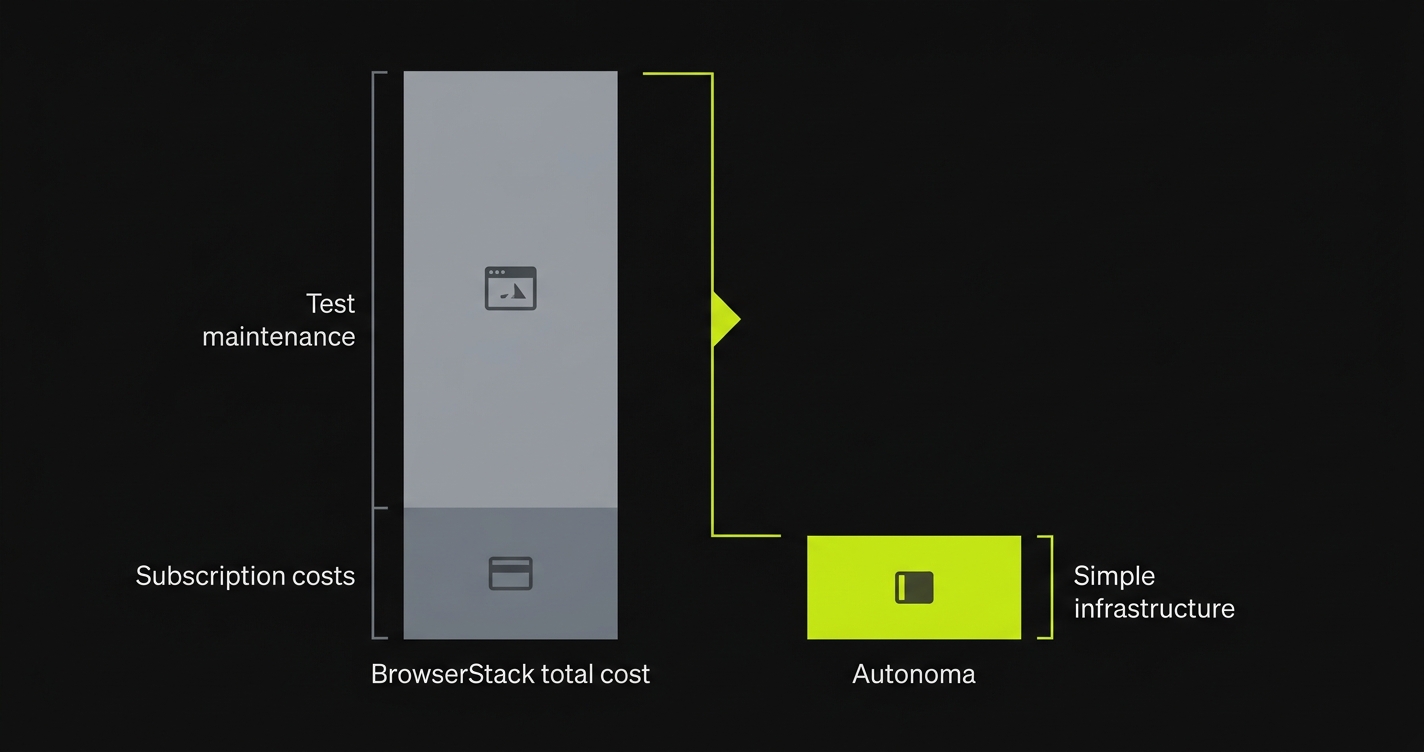
The real cost of BrowserStack is not just the subscription; it is the subscription plus the engineering hours spent maintaining tests.
For a mid-sized team (15 developers, continuous testing), BrowserStack costs $150-375/month in subscription fees ($1,800-4,500/year). Add 10-15 hours/month of test maintenance (updating broken selectors, debugging flaky tests, rewriting scripts after UI changes) at typical engineering rates ($100-150/hour), and maintenance alone costs $12,000-27,000 per year. Over three years, the total comes to $60K-70K when you combine subscription and maintenance.
Autonoma cloud is $499/month ($18K over three years) with zero maintenance hours. AI self-healing handles UI changes automatically. That represents a 71-73% cost reduction.
Autonoma self-hosted eliminates the platform fee entirely. You pay only for the infrastructure you provision on AWS, GCP, or Azure, typically $200-400/month depending on your parallel needs. Over three years, that totals roughly $11K: an 84% reduction compared to BrowserStack's total cost of ownership.
The biggest savings is not the subscription difference. It is the elimination of test maintenance through AI self-healing. That is where BrowserStack's hidden cost lives, and it is the line item most teams underestimate when evaluating testing platforms.
Migrating from BrowserStack to Autonoma
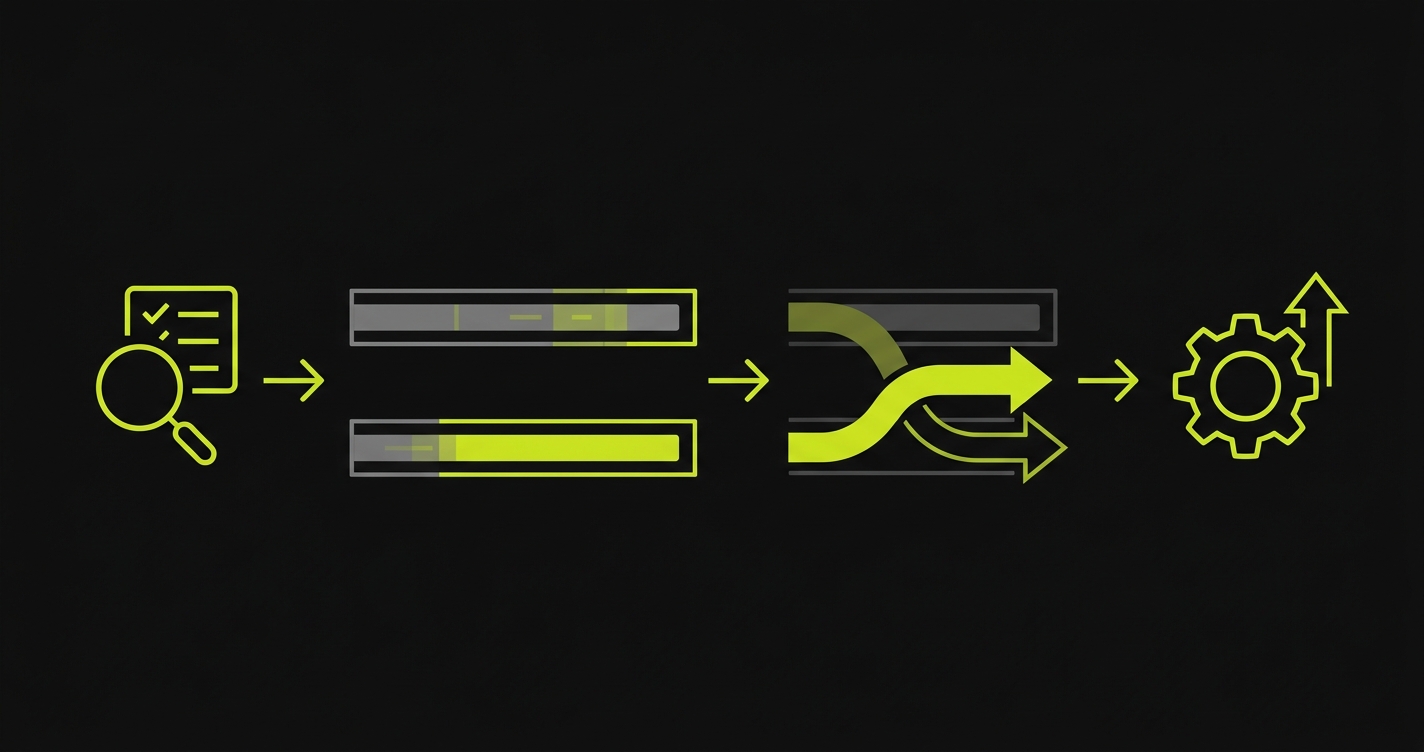
Migration is simpler than you would expect because you are not rewriting tests. Autonoma generates them from your codebase. Most teams complete the process in 1-2 weeks.
1. Connect your repo. Sign up for the free tier at getautonoma.com or self-host by cloning the GitHub repo and following the deployment docs. Connect your GitHub repository and let Autonoma's AI analyze your codebase (routes, components, and user flows). This takes minutes, not days.
2. AI generates tests. The test-planner-plugin builds a knowledge base of your application and generates comprehensive E2E test cases automatically. Start with 5-10 critical flows (checkout, authentication, core features) and run them in parallel with your existing BrowserStack suite to compare results side by side. This gives you a direct comparison of reliability, execution speed, and coverage without risk.
3. Validate coverage. Compare AI-generated test coverage against your existing suite. Autonoma's vision-based tests are often more resilient than selector-based BrowserStack tests because they understand intent, not DOM structure. Check for gaps, review the AI-generated test plans, and iterate. Most teams achieve full coverage within days, not weeks, because the AI generates tests from your actual codebase rather than requiring manual writing.
4. Update CI/CD and cut over. Point your CI/CD pipelines at Autonoma, train your team on reviewing AI-generated test plans, and cancel your BrowserStack subscription. If you are self-hosting, provision your infrastructure (ECS cluster, database, orchestration) during the validation phase so it is ready for the cutover. The transition is low-risk because you have already validated coverage in step 3.
The key difference from a traditional migration: you are not rewriting 500 tests line by line. You connect your repo, the AI generates coverage, and you validate. The migration effort is about reviewing and verifying, not rebuilding.
Frequently Asked Questions
Yes. Autonoma is an open-source testing platform available on GitHub. Unlike BrowserStack's proprietary closed-source model, Autonoma offers a free tier with 100K credits and full self-hosting capabilities. You can run Autonoma on your own infrastructure with no feature limitations, or use the cloud version starting free.
Yes. Autonoma is fully self-hostable with complete source code on GitHub. You can run it on your infrastructure (AWS, GCP, Azure, on-premise) with zero feature restrictions. BrowserStack offers no self-hosting option; you're locked into their cloud.
BrowserStack costs $150-375/month for teams ($1,800-4,500/year) with limited parallel testing. Autonoma offers a free tier with 100K credits, then $499/month for 1M credits with unlimited parallels. Self-hosting Autonoma eliminates ongoing cloud costs entirely (pay only infrastructure).
Yes. You don't rewrite tests; you connect your repo and Autonoma's AI generates tests from your codebase automatically. Migration involves validating AI-generated coverage against your existing test suite. Most teams achieve full coverage within days. Unlike BrowserStack's selector-based tests, Autonoma's AI uses vision models and understands intent, so tests are more resilient to UI changes long-term.
No. Nobody writes tests; the AI does. Unlike BrowserStack where engineers write and maintain test code, Autonoma generates tests automatically from your codebase. AI agents analyze your routes, components, and user flows, then create comprehensive E2E tests. Team members review test plans and results, but no coding or test writing is required from anyone.
If you're familiar with Kubernetes, Docker, and cloud infrastructure (AWS/GCP/Azure), self-hosting takes 2-4 hours for initial setup. Autonoma provides deployment documentation and infrastructure templates. If you don't have DevOps resources, start with Autonoma cloud ($499/month, fully managed) and migrate to self-hosted later if needed.
The Bottom Line
BrowserStack is closed source, cloud-only, limited on parallels, and locks your tests in a proprietary format. You write and maintain tests manually. The total cost (subscription plus maintenance engineering) runs $60K-70K over three years for a mid-sized team.
Autonoma solves every one of those problems. Full source code on GitHub (BSL 1.1, Apache 2.0 in 2028). Self-host on your infrastructure or use our cloud. AI generates and maintains tests from your codebase: zero manual writing, zero maintenance. Unlimited parallels on every plan. No vendor lock-in. Free tier starts at 100K credits, cloud at $499/month, self-hosted at infrastructure cost only. Three-year savings: 71-88% depending on deployment model.
Ready to try open source testing?
Start Free - 100K credits, no credit card, 5-minute setup
View on GitHub - Inspect source code, self-host documentation
Book Demo - See AI self-healing in action
Related Reading: