

Quick summary: Autonoma is the open-source alternative to ACCELQ. Unlike ACCELQ's proprietary, codeless model-based platform (~$70-120/user/month, no self-hosting), Autonoma's AI reads your codebase and generates tests automatically: no manual model building required. Full source code on GitHub (BSL 1.1), self-hosting on any infrastructure, vision-based self-healing, unlimited parallel execution, no vendor lock-in. Free tier: 100K credits. Cloud: $499/month. Self-hosted: no ongoing costs.
ACCELQ markets itself as a "codeless" testing platform with a "design once, run anywhere" promise. The pitch is appealing: build test flow models through a visual interface, skip the coding, and execute across web, API, mobile, and desktop. But "codeless" is misleading. You are not coding, but you are still doing substantial manual work: drawing flow models, configuring logic, mapping objects, and maintaining everything when your application changes.
For teams evaluating ACCELQ in 2026, the question is not whether codeless beats coded. It is whether manual model-building beats AI that reads your code and generates tests autonomously. Autonoma is the open-source alternative that eliminates manual work entirely. This guide covers where ACCELQ falls short, how Autonoma solves those problems, and how to migrate.
Where ACCELQ Falls Short
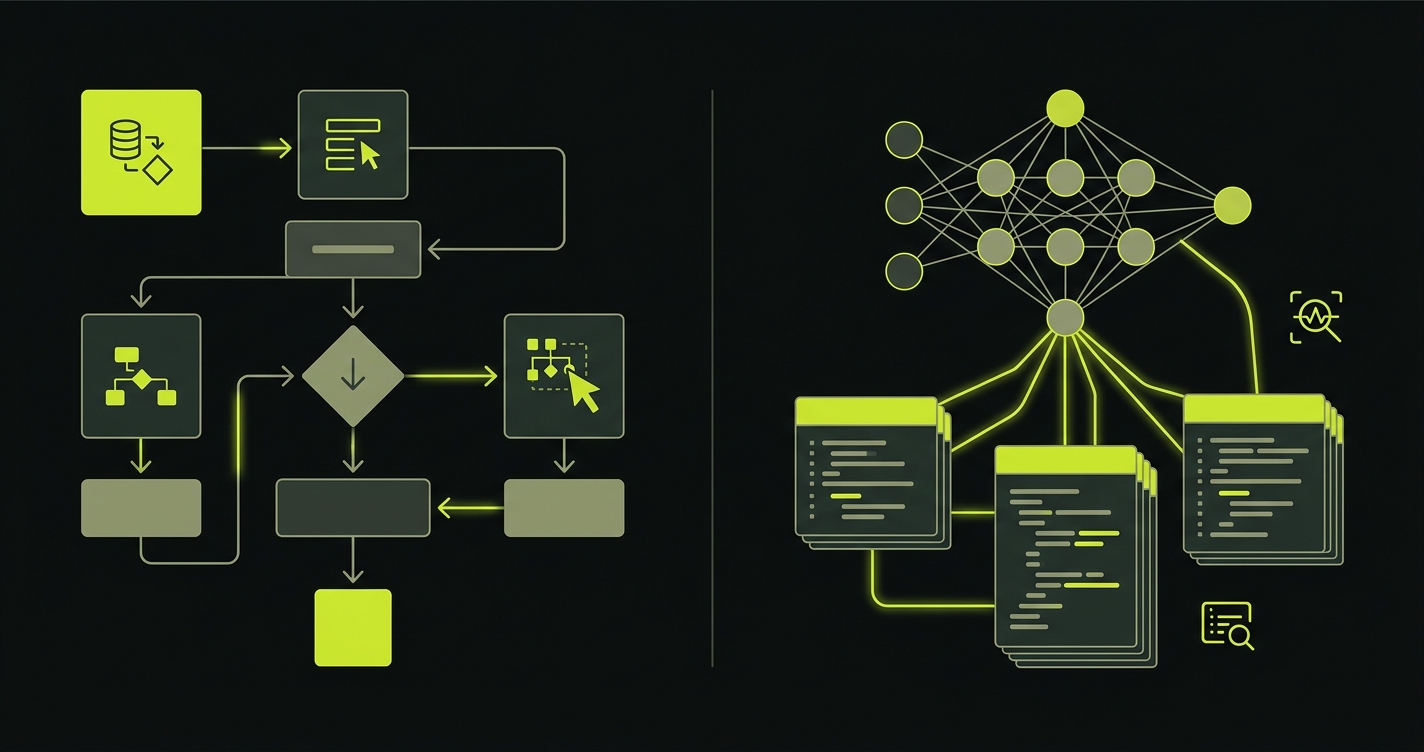
Three core problems drive engineering teams away from ACCELQ's model-based approach.
"Codeless" Still Means Manual
ACCELQ replaces code with visual flow models. You drag and drop actions, configure steps, map UI objects, and build test logic through their model designer. This is easier than writing Selenium scripts, but it is not "automated" in any meaningful sense. You are still manually building every test flow. Every screen, every interaction, every assertion: modeled by hand.
When your application changes, those models break. A redesigned checkout flow means rebuilding the checkout model. A new form field means updating every flow that touches that form. ACCELQ calls this "model-based maintenance" and positions it as simpler than code maintenance. It is simpler, but it is still manual maintenance that consumes engineering hours every sprint.
One QA lead described it this way: "We replaced writing code with drawing flowcharts. The work didn't disappear, it just changed shape. We still spend 15-20 hours a week maintaining test models after every release."
The fundamental issue: ACCELQ automates test execution but not test creation or maintenance. You build the models. You maintain the models. ACCELQ runs them. That is not automation in the way modern AI-native tools define it.
Closed Source with No Self-Hosting
ACCELQ is entirely proprietary. No source code access. No self-hosting option. Your test models, execution data, application credentials, and results all live on ACCELQ's infrastructure. You cannot inspect how models execute under the hood, audit their security practices, or customize platform behavior.
For teams with compliance requirements: HIPAA, PCI DSS, SOC 2, FedRAMP: this is often a non-starter. Testing infrastructure that handles application credentials and user data needs to run on auditable, controlled environments. ACCELQ cannot provide source code for review, and their cloud-only model means your data is always on their servers.
Even without strict compliance, the lack of transparency creates practical problems. When a model behaves unexpectedly, you cannot debug the execution engine. When ACCELQ's cloud has an outage, your CI/CD pipeline stalls. When their pricing changes, you have no alternative: your entire test suite exists in their proprietary format.
Expensive Per-User Pricing That Scales Poorly
ACCELQ's pricing runs approximately $70-120 per user per month, depending on the tier and contract terms. That does not sound extreme for a single user, but it scales poorly for growing teams.
A team of 5 pays $4,200-7,200/year. A team of 10 pays $8,400-14,400/year. A team of 20 pays $16,800-28,800/year. And these are just the license costs. Add the engineering time spent building and maintaining models (15-20 hours/week at typical QA rates), and the true cost of ownership climbs dramatically.
The per-user model also creates perverse incentives. Teams limit who can access the platform to control costs, which means fewer eyes on test quality and slower feedback cycles. QA becomes a bottleneck because only licensed users can create or modify test models.
Compare that to platforms with flat pricing or self-hosting options, and the economics become hard to justify: especially when AI-native alternatives eliminate the manual model-building time that makes up the bulk of testing costs.
Autonoma: The Open Source Alternative to ACCELQ
Autonoma is an open-source, AI-native testing platform that solves every problem above: no manual modeling, full source code, self-hosting, and flat pricing with no per-user charges.
AI Generates Tests: No Models to Build
This is the core difference from ACCELQ. Instead of manually building flow models in a visual designer, you connect your GitHub repo and Autonoma's AI reads your codebase.
How it works: Autonoma's test-planner-plugin analyzes your routes, components, and user flows to build a knowledge base of your application. AI agents then generate comprehensive E2E test cases based on your actual code structure. No manual model building. No flowchart drawing. No object mapping. The AI understands your application from the source code and produces tests that cover real user journeys.
Tests execute using AI vision models that see your application like a human would. No CSS selectors, no XPaths, no object repositories to maintain. When your UI changes: a button moves, a form gets redesigned, a flow is restructured: the AI adapts automatically because it understands intent, not DOM structure. This is fundamentally different from ACCELQ's model-based approach, where UI changes require manual model updates.
ACCELQ's "codeless" promise removes the need to write test code. Autonoma's AI promise removes the need to do any manual work at all. No code. No models. No flowcharts. No object maps. The AI handles the entire testing lifecycle: understanding your codebase, generating tests, executing them, and maintaining them when your application evolves.
Open Source and Self-Hosting
Full source code on GitHub. Licensed under BSL 1.1 (converts to Apache 2.0 in 2028). You can use it in production, inspect every line, audit security, and self-host with no feature restrictions. The only limitation: you cannot resell Autonoma's functionality as a commercial service.
Run Autonoma on your infrastructure: AWS (ECS, EKS, or EC2), GCP (GKE or Compute Engine), Azure (AKS or VMs), or your own data center. When you self-host, your data never leaves your infrastructure. Test credentials stay on your servers. Application URLs are never exposed to external systems. This directly solves the compliance problem that makes ACCELQ a non-starter for regulated industries.
The technology stack is standard open source: TypeScript and Node.js 24 for the runtime, Playwright for web testing, Appium for mobile testing, PostgreSQL for data storage, and Kubernetes for orchestration. No proprietary runtimes, no black-box components, no ACCELQ-style vendor lock-in.
Flat Pricing with No Per-User Charges
Unlike ACCELQ's per-user pricing that scales linearly with team size, Autonoma uses flat pricing:
Free tier: 100K credits, no credit card required, unlimited parallels, all features included. Good for small teams, startups, and evaluating the platform.
Cloud ($499/month): 1M credits per month, unlimited parallels, managed infrastructure, support included. No per-user charges: your entire team uses it at one price.
Self-hosted (free platform): No ongoing platform fees. Pay only for infrastructure (AWS/GCP/Azure). No feature restrictions. No per-user charges. Full control over data, environment, and scaling.
For a team of 10, ACCELQ costs $8,400-14,400/year in licenses alone. Autonoma cloud costs $5,988/year total: and that includes unlimited users. Self-hosted Autonoma costs only your infrastructure spend, typically $200-400/month ($2,400-4,800/year) with no user limits.
Unlimited Parallel Execution
Every Autonoma plan supports unlimited parallel test execution. On the free tier, that is subject to credit limits, but on cloud and self-hosted plans your test suite scales with your infrastructure. Add more tests, spawn more instances. No negotiations, no pricing tiers, no artificial caps.
ACCELQ's parallel execution depends on your license tier and agent allocation. Scaling parallelism means paying for additional agents, which adds to the already expensive per-user cost. With Autonoma, parallel capacity is limited only by the compute resources you allocate: and you can auto-scale those based on demand.
Cross-Platform Coverage
Autonoma covers web testing via Playwright (Chrome, Firefox, Safari across desktop and mobile viewports) and mobile testing via Appium (iOS simulators, Android emulators, and physical devices). API testing is handled through AI-generated test cases that cover your backend endpoints.
ACCELQ covers web, API, mobile, and desktop (including mainframe and ERP systems like SAP, Salesforce). If you need desktop application testing or mainframe integration, ACCELQ has broader surface area. But for teams focused on web and mobile: which is the vast majority of modern applications: Autonoma provides equivalent coverage with the massive advantage of AI-generated tests that require zero manual modeling.
ACCELQ vs Autonoma: Feature Comparison
| Feature | ACCELQ | Autonoma |
|---|---|---|
| Open Source | Proprietary closed source | BSL 1.1 on GitHub (Apache 2.0 in 2028) |
| Self-Hosting | Cloud only, no self-hosting | Self-host anywhere (AWS, GCP, Azure, on-prem) |
| Test Creation | Manual model building (visual flowcharts) | AI generates tests from codebase automatically |
| Test Maintenance | Manual model updates when UI changes | AI self-healing (zero maintenance) |
| Approach | Codeless model-based (manual modeling) | AI-native autonomous (zero manual work) |
| Vendor Lock-In | High (proprietary model format) | None (tests generated from code, fork codebase) |
| Parallel Execution | Depends on license tier and agents | Unlimited on all plans |
| Web Testing | Chrome, Firefox, Safari, Edge, IE | Chrome, Firefox, Safari (Playwright) |
| Mobile Testing | iOS and Android | iOS and Android (Appium) |
| API Testing | Built-in API testing | AI-generated API test cases |
| Desktop Testing | Windows desktop, SAP, Salesforce | Not supported |
| Pricing Model | Per-user ($70-120/user/month) | Flat pricing (no per-user charges) |
| Starting Price | ~$70/user/month | Free (100K credits) |
| Team of 10 (Annual) | $8,400-14,400/year | $5,988/year (cloud) or infrastructure only (self-hosted) |
| Source Code Access | No access | Full source code on GitHub |
| Data Sovereignty | Data on ACCELQ servers | Data stays on your infrastructure (self-hosted) |
| Learning Curve | Moderate (model-based design takes training) | Low (connect repo, AI generates tests) |
| CI/CD Integration | Jenkins, Azure DevOps, Bamboo | GitHub Actions, any CI/CD via API |
Cost: Model-Based vs AI-Native
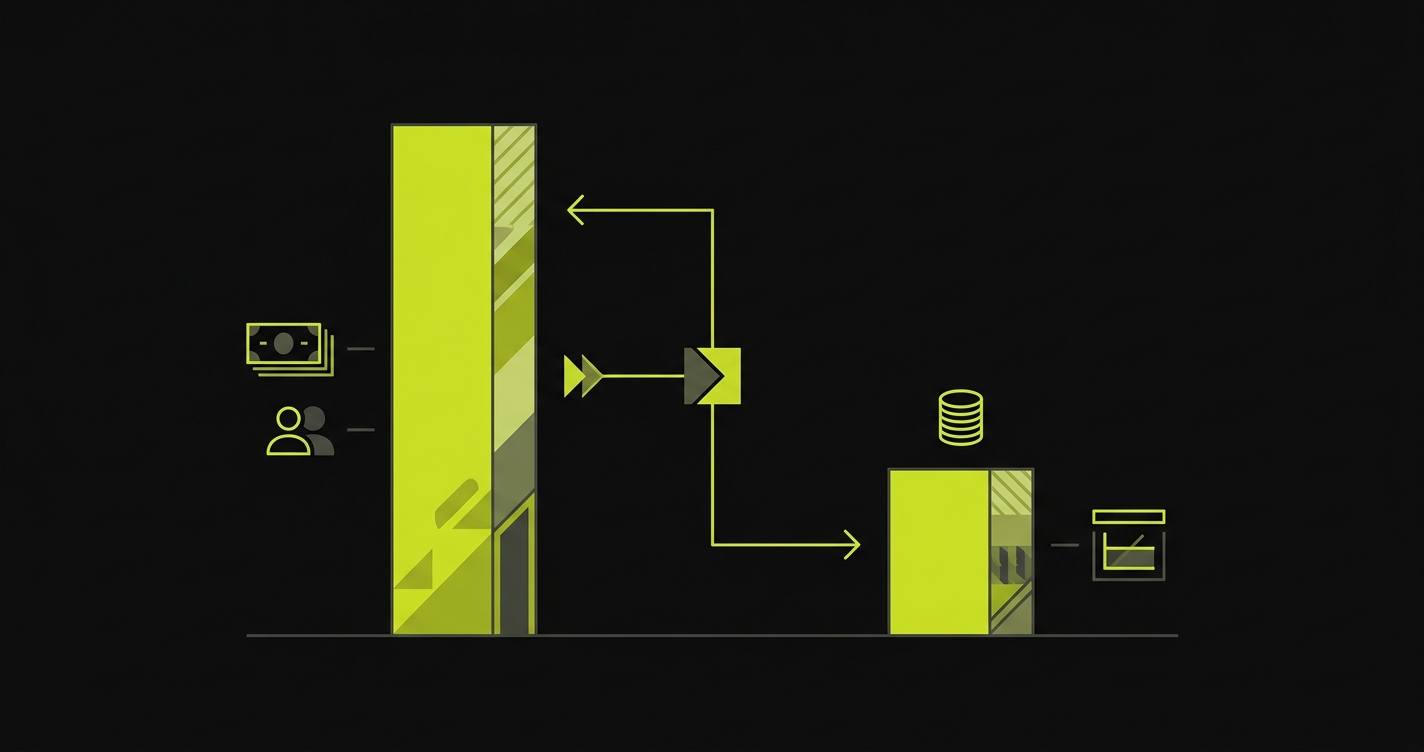
The real cost of ACCELQ is not just the license fees: it is the engineering time spent building and maintaining flow models.
For a mid-sized team (10 QA engineers, continuous testing), ACCELQ license costs run $8,400-14,400/year. Add 15-20 hours/week of model building and maintenance across the team (at typical QA rates of $60-100/hour), and the manual work costs $46,800-104,000 per year. Over three years, the total cost of ownership reaches $165K-355K when you combine licenses and labor.
Autonoma cloud costs $5,988/year with zero manual work. AI generates and maintains all tests. No models to build, no flowcharts to draw, no objects to map. Three-year cloud cost: $17,964. That is an 89-95% reduction in total cost of ownership.
Autonoma self-hosted eliminates the platform fee entirely. Infrastructure costs typically run $200-400/month ($2,400-4,800/year). Three-year total: $7,200-14,400. That is a 96% reduction compared to ACCELQ's total cost of ownership.
The savings come from two places: lower platform costs (flat pricing vs per-user) and eliminated labor (AI vs manual modeling). The labor savings alone justify the switch for most teams, even before you factor in the license cost difference.
Migrating from ACCELQ to Autonoma
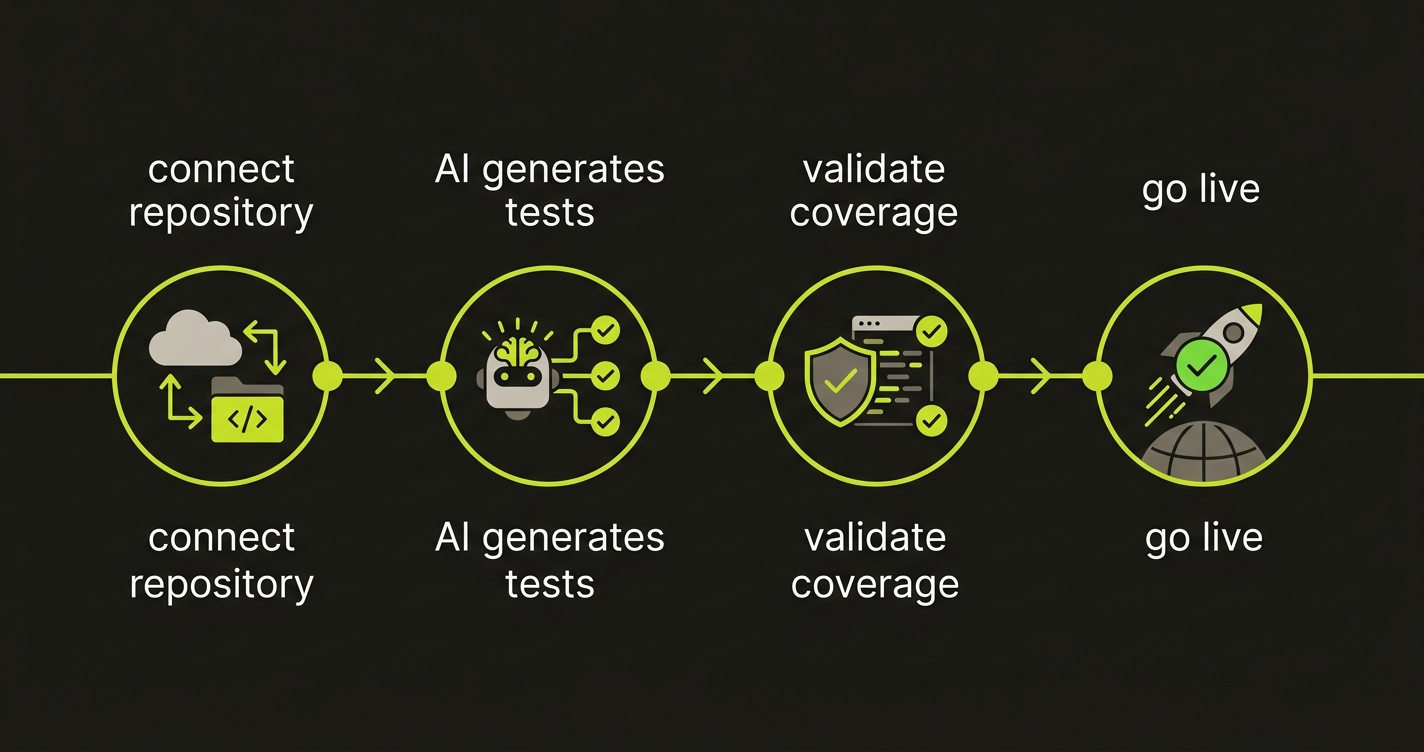
Migration from ACCELQ to Autonoma is not a model-by-model translation. You do not rebuild your ACCELQ flow models in a different tool. You connect your repo and let AI generate fresh test coverage from your codebase. This is faster and produces more resilient tests.
1. Connect your repo. Sign up for the free tier at getautonoma.com or self-host by cloning the GitHub repo and following the deployment docs. Connect your GitHub repository and let Autonoma's AI analyze your codebase. This takes minutes.
2. AI generates tests. The test-planner-plugin builds a knowledge base of your application and generates comprehensive E2E test cases automatically. Start with your most critical flows: the ones that take the most effort to maintain in ACCELQ. Run them in parallel with your existing ACCELQ suite to compare coverage and reliability.
3. Validate coverage. Compare AI-generated test coverage against your ACCELQ models. Because Autonoma's tests are vision-based and understand intent rather than relying on object mappings, they are typically more resilient to UI changes. Check for coverage gaps, review the AI-generated test plans, and iterate. Most teams achieve full coverage within days.
4. Update CI/CD and cut over. Point your CI/CD pipelines at Autonoma, decommission your ACCELQ integration, and cancel the subscription. If self-hosting, provision your infrastructure during the validation phase so it is ready for cutover.
The key insight: you are not migrating models. You are replacing manual model-building with AI generation. The effort is in validating coverage, not rebuilding tests. Most teams complete the transition in 1-2 weeks.
Frequently Asked Questions
Yes. Autonoma is an open-source testing platform available on GitHub. Unlike ACCELQ's proprietary closed-source model, Autonoma offers a free tier with 100K credits and full self-hosting capabilities. You can run Autonoma on your own infrastructure with no feature limitations, or use the cloud version starting free.
Yes. Autonoma is fully self-hostable with complete source code on GitHub. You can run it on your infrastructure (AWS, GCP, Azure, on-premise) with zero feature restrictions. ACCELQ offers no self-hosting option; you're locked into their cloud.
ACCELQ costs approximately $70-120 per user per month ($840-1,440/user/year). For a team of 10, that's $8,400-14,400 per year in licenses alone. Autonoma offers a free tier with 100K credits, then $499/month flat (no per-user charges) for 1M credits with unlimited parallels. Self-hosting Autonoma eliminates ongoing cloud costs entirely.
ACCELQ is 'codeless': you don't write code, but you manually build flow models through a visual interface. Every test flow is designed by hand. Autonoma is AI-native: you connect your repo and AI generates tests from your codebase automatically. No code, no models, no manual work. ACCELQ automates execution; Autonoma automates the entire lifecycle including creation and maintenance.
Yes. You don't need to recreate your ACCELQ flow models. Connect your repo and Autonoma's AI generates tests from your codebase automatically. Migration involves validating AI-generated coverage against your existing ACCELQ suite. Most teams achieve full coverage within days because the AI generates tests from actual code, not manual model definitions.
Yes. Autonoma supports web testing via Playwright (Chrome, Firefox, Safari) and mobile testing via Appium (iOS and Android). API testing is supported through AI-generated test cases that cover your backend endpoints. ACCELQ additionally supports desktop applications (Windows, SAP, Salesforce) which Autonoma does not cover.
ACCELQ is codeless in the sense that you don't write programming code, but you still do significant manual work. You build flow models, configure test logic, map objects, and maintain models when the UI changes. It replaces coding with visual model-building, but the effort is still substantial: typically 15-20 hours per week for a mid-sized team. Autonoma eliminates both coding and manual modeling.
The Bottom Line
ACCELQ promises "codeless" testing, but it replaces code with manual model-building that still consumes significant engineering time. It is closed source, cloud-only, uses per-user pricing that scales poorly, and locks your test suite in a proprietary format. The total cost of ownership: licenses plus modeling labor: reaches $165K-355K over three years for a mid-sized team.
Autonoma is the open-source alternative that eliminates manual work entirely. Full source code on GitHub (BSL 1.1, Apache 2.0 in 2028). Self-host on your infrastructure or use our cloud. AI reads your codebase and generates tests automatically: no models, no flowcharts, no object mapping. Unlimited parallels on every plan. Flat pricing with no per-user charges. Free tier starts at 100K credits, cloud at $499/month, self-hosted at infrastructure cost only. Three-year savings: 89-96% depending on deployment model.
Ready to try open source testing?
Start Free - 100K credits, no credit card, 5-minute setup
View on GitHub - Inspect source code, self-host documentation
Book Demo - See AI test generation in action
Related Reading: