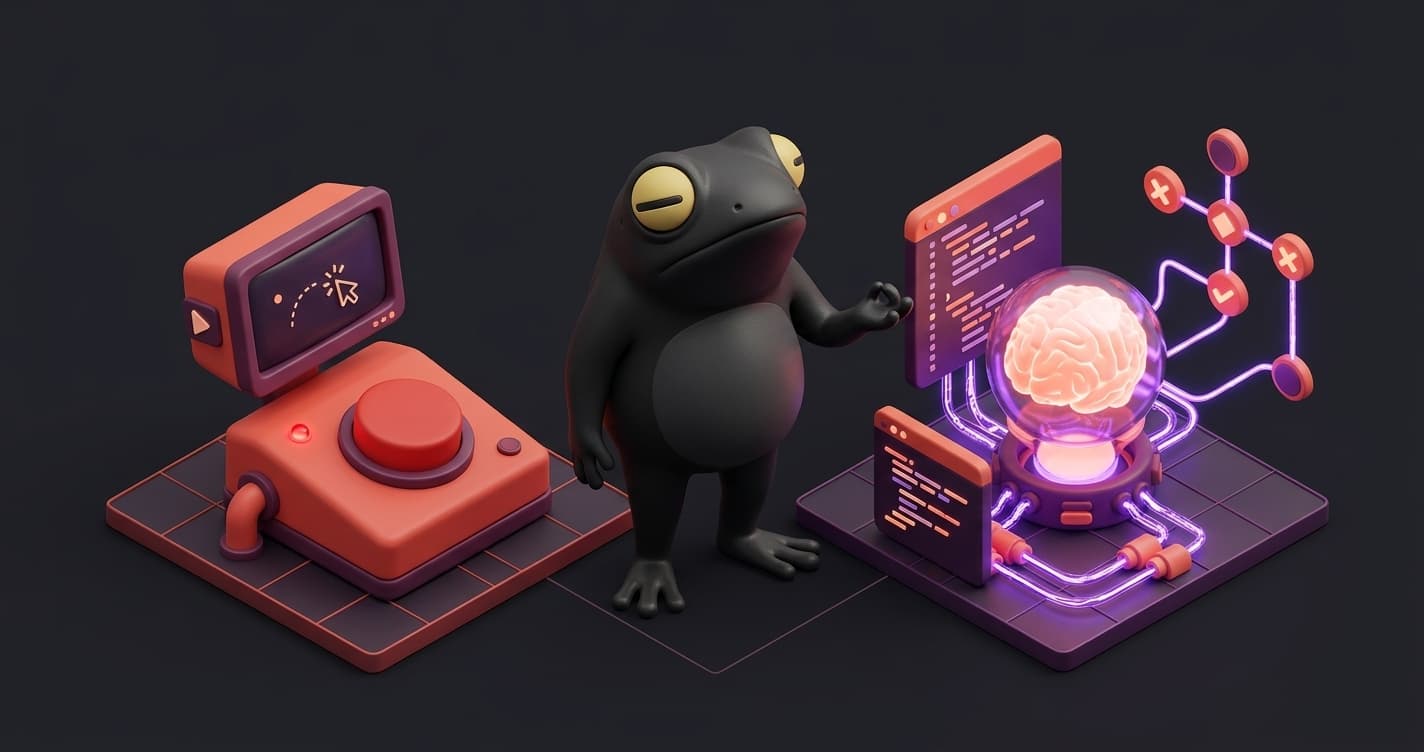

Codeless test automation (record-and-playback, visual test builders) lets teams achieve test automation without coding by recording user interactions and replaying them. AI-native testing (agent-based tools like Autonoma) skips the recording entirely: agents read your codebase, understand your user flows from the code itself, and generate tests automatically. The core difference is where test intent comes from. Codeless captures what a human clicked. AI-native derives what the application is supposed to do. In 2026, both approaches let non-engineers create tests without scripting, but only one scales past a few hundred tests without becoming a maintenance job in its own right. This article compares both paradigms across setup, maintenance, coverage depth, and scaling, and maps out an honest decision framework for which to use.
Codeless testing was a genuine breakthrough when it arrived. Before it, getting test coverage on a web application meant hiring engineers who could write Selenium scripts or Cypress tests. That was expensive, slow, and created a bottleneck on every QA team. Record-and-playback tools changed the math. A QA analyst could click through a flow, export it as a test, and have something running in a CI pipeline by afternoon.
That was the promise. And for small applications with slow release cycles, it delivered.
Then teams started scaling. The app grew. The release cadence accelerated. AI coding tools arrived and developers started shipping five PRs a day instead of two. The test suite that was supposed to free teams from manual effort became its own maintenance burden, and somewhere along the way the irony set in: no-code test automation was requiring more human intervention than the scripted tests it replaced.
This is not a criticism of the teams that chose codeless tools. It is a criticism of the architecture. And understanding that architectural difference, between codeless and AI-native testing, is what this article is about.
What Codeless Test Automation Actually Is
Codeless test automation is a category, not a single tool. It spans record-and-playback tools, visual test builders, and natural-language-driven platforms. What they share is the interface: instead of writing test code, you interact with the application and the tool captures your interactions as a test.
The appeal is real. No Playwright knowledge required. No TypeScript. A QA analyst can build a regression suite without a software engineer involved. For a full comparison of the tools in this category, see our codeless test automation tools guide and the broader test automation frameworks guide for where codeless sits in the larger landscape.
The fundamental mechanism is selector-based. When you click a button during recording, the tool captures the button's CSS selector, XPath, or test ID. The test replay finds that element and clicks it. The test assertion checks that a particular element appears, or that a URL changes, or that text is visible.
This mechanism works until the UI changes. When a developer renames a class, moves a button, restructures a component, or ships a redesign, the recorded selector no longer matches. The test fails. Someone has to open the test editor, find the broken step, and update the selector. Then push the fix. Then wait for CI. That is one broken test. Now multiply it by the 200 UI changes your team ships in a given sprint.
The other constraint is coverage depth. Codeless tests cover exactly what someone clicked through. They do not know that the registration form has a validation rule for duplicate emails unless someone recorded that specific case. They do not know that the checkout flow has an edge case for expired cards unless someone thought to test it. Coverage is bounded by what humans thought to record.
Where Codeless Testing Breaks Down

The pattern is consistent across teams that have been running codeless suites for more than six months. It starts with confidence: the suite is green, coverage feels solid, no engineers needed. Then velocity increases. Then a redesign happens. Then the maintenance work starts outpacing new test creation.
There are four specific failure modes worth naming.
Selector Fragility
This is the most common failure mode. Codeless tools record selectors at a point in time. UI refactors break them. Modern frontend development with React, Vue, or Svelte involves frequent component restructuring, and each restructure is a batch of selector breakage. Even the Playwright documentation recommends using dedicated test IDs over CSS selectors for exactly this reason. Teams that use AI coding tools see this accelerate further, because AI-generated UI tends to produce more structural changes per PR than human-written code.
Shallow Coverage
Recording a happy path is easy. Recording every validation error, every edge case, every combination of user permissions is not. It requires someone to think of the case, open the tool, click through the flow deliberately, and save it. Most codeless test suites end up with strong happy-path coverage and thin edge-case coverage, which means the bugs that actually reach production are exactly the ones the tests do not catch.
No Understanding of Code Intent
A codeless test knows that "button with id=submit exists and is clickable." It does not know that this button triggers a payment charge. It does not know that the payment flow validates the card number before submitting. That understanding lives in the code, not in the recorded interaction. When code changes the behavior of that button, the test does not fail unless the visual output changes in a way the recorder captured.
Scaling Economics
Fifty tests in a codeless tool is manageable. Five hundred is a part-time job. Two thousand is a full-time QA role dedicated to maintenance rather than coverage improvement. At that scale, the "no code" part of no-code test automation has become irrelevant: the labor cost is real, it is just maintenance labor instead of authoring labor.
The open-source alternative to Mabl and open-source alternative to testRigor comparisons go into more depth on how specific codeless platforms handle these tradeoffs.
The AI-Native Alternative
Agentic testing takes a fundamentally different approach to the same problem. Instead of recording what a human clicks, AI test generation reads what the code does.
The process starts with your codebase. The Planner agent reads your routes, components, data models, and API contracts. From that analysis, it derives the test cases that matter: what flows exist, what states the application can be in, what inputs should be validated, what edge cases the code anticipates. The codebase is the spec.
From that planning step, tests are generated automatically. Not just happy paths. Validation errors, permission edge cases, error states, and the database scenarios needed to test each case. The Planner agent also generates the endpoints needed to put the database in the right state for each test scenario, so state setup is not a manual configuration task.
Then the Executor agent runs those tests against a live preview environment, and the Reviewer agent classifies each result as a real bug, an agent error, or a test-plan mismatch. When your code changes, the Diffs Agent picks up the diff and runs, adding, deprecating, or maintaining the affected test cases automatically.
The practical difference in coverage depth is significant. Take user registration as a concrete example.
A codeless tool records the happy path: fill in name, email, password, click submit, confirm the success state. Maybe a QA analyst also records the "invalid email" case if they think of it. The suite has one or two tests for this flow.
When Autonoma reads the registration route, it finds the validation schema, the duplicate-email check, the password strength requirements, the rate limiting logic, and the redirect behavior after success. It generates tests for all of those cases without anyone having to think of them individually. The coverage that would have taken a QA analyst a day to record takes an automated planning pass to generate.
This is not a small difference. It is the difference between a test suite that catches regressions in edge cases and one that only catches regressions in the cases someone happened to click through.
Codeless vs AI-Native: Head-to-Head
| Dimension | Codeless (Record and Playback) | AI-Native (Autonoma) |
|---|---|---|
| Initial setup time | Fast: record a flow and have a test in minutes; no technical knowledge required | Medium: connect codebase and run initial agent pass; first results in hours rather than minutes |
| Test creation method | Human records interactions; test captures selectors and actions from a click-through session | Planner agent reads codebase; derives test cases from routes, components, and data models automatically |
| Handling UI changes | Selector breakage on every structural change; manual updates required for each broken step | Diffs Agent self-heals when code changes; understands intent, not just selectors |
| Coverage depth | Bounded by what humans recorded; strong on happy paths, thin on edge cases and validation | Derived from code analysis; covers validation rules, error states, and edge cases the code anticipates |
| Test maintenance | Manual: every selector, assertion, and flow must be updated when UI or behavior changes | Automated: self-healing handles routine updates; human review for ambiguous behavior changes |
| Understanding of the app | None: tests are recordings of interactions, not representations of application logic | Deep: agents read routes, components, and data models; tests reflect what the application is meant to do |
| Scaling to 1000+ tests | Expensive: maintenance burden grows linearly with suite size; requires dedicated QA labor | Manageable: maintenance handled by the Diffs Agent; coverage expands automatically as codebase grows |
| Skill required | Very low: any QA analyst or non-technical team member can record tests | Low to medium: connecting a codebase is straightforward; reviewing agent decisions requires testing judgment |
| Database state setup | Manual: fixtures and seed scripts written separately; often a blocker for complex flows | Automated: Planner agent generates endpoints to set database state for each test scenario |
| Cost at scale | Platform fee plus significant maintenance labor; cost grows with suite size and release velocity | Platform fee; maintenance labor drops sharply as agent handles routine upkeep |
The initial setup comparison is genuinely in codeless's favor. Recording a flow takes minutes. Connecting a codebase to an AI-native tool and running an initial planning pass takes hours. For teams that need something working today, that matters.
Everything else shifts as the suite grows and the release cadence accelerates. The maintenance cost of a codeless suite at 500 tests is a full-time job. The maintenance cost of an AI-native suite at 500 tests is a weekly review session.
The Coverage Gap in Practice
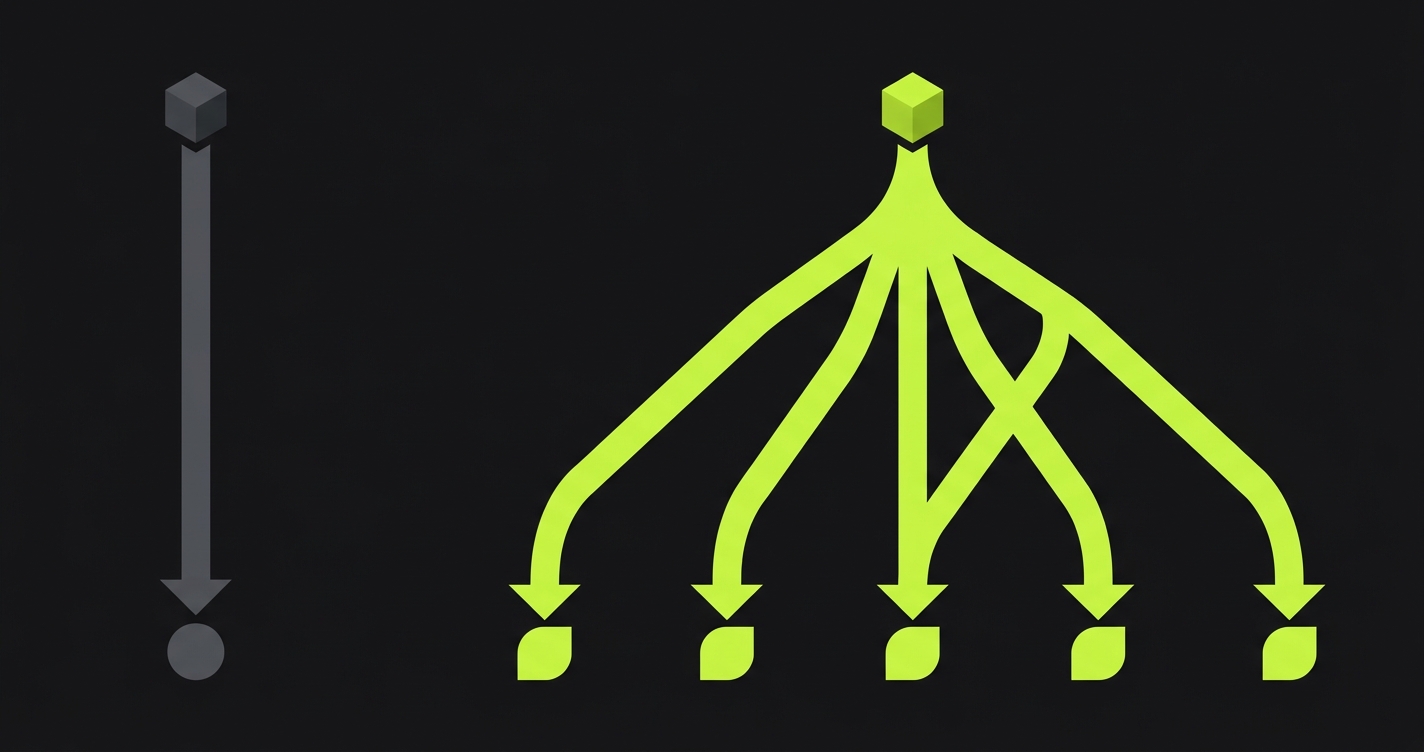
The coverage gap between codeless and AI-native testing is most visible when something breaks in production that the test suite did not catch.
Consider what a codeless test for user registration actually covers. Someone on the QA team recorded: open registration page, enter valid credentials, submit, confirm redirect to dashboard. Maybe they also recorded the "password too short" error case. The test suite has two tests. Everything else -- duplicate email handling, invalid email format, rate limiting, the behavior when the auth service is down -- is untested.
An AI-native Planner agent reading the same registration route finds the validation middleware, the database uniqueness constraint, the rate limiter configuration, and the error handling paths. It generates test cases for each of those. Not because someone thought to ask for them. Because they are in the code.
This is the core advantage of treating the codebase as the spec rather than a human recording session as the spec. The code already encodes what the application is supposed to do. AI-native testing reads that encoding directly.
The gap compounds over time. When a developer adds a new validation rule to the registration endpoint, an AI-native system picks it up on the next planning pass and adds a test. A codeless suite does not know the validation rule exists unless someone goes back and records a new test case for it. Coverage drift, the gap between what the application does and what the tests cover, is a structural outcome of the codeless model. It is not a failure of discipline; it is a consequence of the architecture.
Decision Framework: When to Use Each
Being fair here matters. Codeless testing is not wrong. As Martin Fowler's testing pyramid reminds us, different testing strategies serve different layers. For specific contexts, codeless is still the right choice.
When Codeless Makes Sense
The application is relatively stable. If the UI changes quarterly rather than daily, selector maintenance is a low-burden task. Record the flows once and run them. The economics are fine.
The team has no engineering involvement in testing. If the testing function is entirely owned by non-technical QA analysts and there is no appetite for connecting a codebase or reviewing agent decisions, the barrier to codeless is lower.
The scope is smoke tests only. Quick checks that core flows are working, run before a release, are well-suited to a small codeless suite. Twenty tests covering the five most critical user journeys is a legitimate use of record-and-playback.
The codebase is too opaque for AI analysis. If the application is a legacy system where routes and components do not cleanly map to user flows, AI-native planning struggles to derive meaningful test cases. Codeless works on the surface of any application regardless of what is inside.
When AI-Native Is the Right Choice
UI changes happen frequently. Any team shipping multiple PRs per day, or using AI coding tools to accelerate development, will see their codeless suite break constantly. The maintenance cost becomes untenable faster than expected.
Edge case coverage matters. If production bugs are regularly being caught in cases that the happy-path tests missed, that is a signal the coverage model is wrong. AI-native coverage addresses this structurally.
The team wants to stop thinking about test maintenance. Self-healing is the capability that changes the operational model. When the test suite maintains itself, QA shifts from maintenance to coverage policy, which is a fundamentally more valuable use of time. For the full breakdown of how AI-driven self-healing tests work, including what they fix and what they deliberately don't, see our dedicated guide.
Scaling past a few hundred tests. The economics of codeless maintenance at scale are reliably bad. The economics of AI-native maintenance at scale are reliably good. The crossover point varies by team, but most teams hit it between 200 and 400 tests.
For the broader transformation context, the QA process improvement guide maps out what the shift from codeless to AI-native actually looks like inside a team.
Migration: Start With the Tests That Break Most
The migration from codeless to AI-native does not require abandoning your existing test suite on day one. The right starting point is the tests that break most often.
Every codeless suite has a set of tests that fail almost every sprint. Usually it is the flows that touch UI components that change frequently, the registration and onboarding flows, the settings pages, the dashboards. These are the tests that consume the most maintenance time, and they are the best candidates for AI-native replacement.
Connect your codebase to Autonoma, let the Planner agent run on the routes those flows cover, and compare the resulting tests against your existing codeless suite. The coverage will likely be broader and the maintenance burden will drop to near zero. Run both suites in parallel for a sprint or two. When you trust the AI-native coverage, retire the codeless tests for that surface.
Then expand. New features do not need a codeless test recorded at all. The agent generates coverage as part of the natural planning pass. Over time, the codeless suite shrinks to the surfaces where it still makes sense (stable, rarely-changing flows) and the AI-native suite covers everything that moves.
This is a graduation, not an abandonment. Codeless testing got QA to a place where non-engineers could create coverage without writing code. AI-native testing removes the recording step entirely, because the code already contains everything you need to know about what the application should do.
Codeless test automation lets teams create tests without writing code. The most common form is record-and-playback: you interact with your application, the tool captures your actions as a test, and you replay that recording in CI. Visual test builders and natural-language-driven platforms are also in this category. The common thread is that test creation does not require programming knowledge.
The main limitation is selector fragility combined with shallow coverage. Codeless tests are recordings of selectors and actions. When the UI changes, selectors break and tests require manual updates. Coverage is also bounded by what someone recorded: edge cases, validation errors, and error states only appear in the suite if someone deliberately clicked through them. Neither problem is fixable within the codeless architecture; they are structural constraints of the record-and-playback model.
AI test generation reads your codebase rather than recording your interactions. Instead of capturing selectors from a click-through session, an AI agent analyzes your routes, components, data models, and validation logic, then derives test cases from that analysis. The result is deeper coverage (edge cases the code anticipates, not just cases someone clicked through) and self-healing maintenance (tests update when code changes rather than breaking on selector changes).
The most popular automated QA testing tools in the no-code category include Mabl, TestRigor, Katalon, Testim, and Leapwork. Each takes a slightly different approach: Mabl leans on AI-assisted recording, TestRigor uses plain-English test specifications, and Katalon is a full-platform tool with both codeless and scripted modes. For a full comparison, see our codeless test automation tools guide. If you are evaluating the best no-code testing platform for your team, the head-to-head comparison in this article applies to all of them.
Yes. The recommended approach is to start with parallel coverage: keep your existing codeless suite running and add AI-native coverage for new features or the flows that break most often. Compare the results. When you trust the AI-native coverage on a given surface, retire the codeless tests for that surface. Most teams end up with a hybrid for a period, with AI-native covering frequently-changing surfaces and codeless tests remaining for stable flows that were recorded once and never need updating.
Autonoma's Planner agent reads your codebase directly: routes, components, data models, and API contracts. From that analysis, it derives the test cases that cover your application's intended behavior, including edge cases and validation rules that the code anticipates. No one records a click-through session. The Diffs Agent then keeps those tests passing as your code evolves, adding, deprecating, or updating test cases on every pull request, while the Executor and Reviewer agents run the suite against a live preview environment and classify each result. The result is a continuously-maintained test suite that reflects the current state of your code, not a snapshot of what someone clicked through at a point in time.


