

Quick summary: Autonoma is the open-source alternative to Sauce Labs. Unlike Sauce Labs' proprietary enterprise platform ($149-249/user/month, complex SKU pricing, no source code access), Autonoma generates tests automatically from your codebase using AI agents. Full source code on GitHub (BSL 1.1), self-hosting for real compliance auditability, vision-based self-healing, unlimited parallel execution, no vendor lock-in. Free tier: 100K credits. Cloud: $499/month. Self-hosted: no ongoing costs.
Sauce Labs has been an enterprise testing staple for over a decade. It runs your Selenium and Appium tests on their Virtual Device Cloud (VDC) and Real Device Cloud (RDC), and it comes with the compliance certifications that enterprise procurement teams love: SOC 2 Type II, ISO 27001, GDPR compliance. For large organizations navigating complex vendor approval processes, those badges matter.
But here is the irony. The teams that care most about compliance, data sovereignty, and security auditing are precisely the teams that should be most uncomfortable with Sauce Labs' model. You cannot inspect the source code. You cannot self-host. You cannot verify how your credentials and application data are handled during test execution. You get a compliance certificate, but you cannot audit the platform yourself.
Autonoma is the open-source alternative built for teams that want real transparency, not just certification badges. Full source code on GitHub, self-hosting on your infrastructure or our cloud, AI that generates and maintains tests automatically, unlimited parallel execution, and zero vendor lock-in. This guide covers where Sauce Labs falls short, how Autonoma solves those problems, and how to migrate.
Where Sauce Labs Falls Short
Three core problems drive engineering and compliance teams toward open source alternatives.
Enterprise Pricing That Punishes Growth
Sauce Labs' pricing model is one of the most complex in the testing space. Their standard plans start at $149/user/month (Virtual Device Cloud only) and go up to $249/user/month for cross-browser plus real device access. Enterprise pricing requires custom contracts with separate SKUs for VDC, RDC, API testing, visual testing, and error reporting. Each capability is a separate line item.
For a 10-person QA team on the standard plan, you are looking at $18,000-$30,000 per year before you even negotiate enterprise features. Teams of 25+ routinely pay $75,000-$150,000 annually. And parallel execution is capped by tier: want more concurrency, pay more per user or negotiate a higher plan. The cost scales linearly with team size, which punishes growing organizations.
One engineering director told us: "Every time we hire a new QA engineer, it costs us $3,000/year just in Sauce Labs seats before they write a single test."
The separate SKU model means you can easily end up paying for VDC, RDC, and visual testing as three different products from the same vendor. Compare that to Autonoma's flat $499/month for everything, or free self-hosting with no per-user charges.
Compliance Certifications Without Transparency
This is the deepest contradiction in Sauce Labs' value proposition. They market heavily to compliance-conscious enterprises with SOC 2 Type II and ISO 27001 certifications. These certifications are legitimate and represent real investment in security practices. But they do not solve the fundamental problem: you cannot audit the platform yourself.
When your security team needs to verify how test credentials are stored, they get a SOC 2 report, not source code access. When your compliance auditors want to understand data flow during test execution, they get a whitepaper, not an architecture diagram they can verify against actual code. When a vulnerability is discovered, you file a support ticket and hope for a timely patch; you cannot patch it yourself or even verify the fix.
For teams operating under HIPAA, PCI DSS, FedRAMP, or strict internal security policies, the inability to self-host and audit source code creates real risk. Your application URLs, login credentials, API keys, and test data all flow through Sauce Labs' infrastructure. You trust their certifications, but you cannot verify their implementation.
Autonoma flips this model. Self-host on your infrastructure, audit every line of source code, and verify data handling yourself. For compliance-conscious teams, this is not a downgrade from Sauce Labs; it is an upgrade.
Manual Test Writing With Limited AI
Sauce Labs is fundamentally a test execution platform. You write Selenium or Appium tests, and Sauce Labs runs them on their device clouds. They have introduced some AI features: AI-powered visual testing, intelligent test suggestions, and failure analysis. But these are incremental additions to a manual testing workflow, not a paradigm shift.
You still write tests. You still maintain selectors. You still debug flaky tests caused by UI changes. When your frontend team ships a redesign, your QA team spends days updating broken locators. Sauce Labs runs the tests faster across more devices, but the fundamental engineering burden of creating and maintaining those tests remains entirely on your team.
The acquisition by Sauce Labs Holdings has also introduced uncertainty about the platform's long-term direction. Enterprise customers we have spoken with express concern about product roadmap stability and the pace of innovation. When you are locked into a proprietary platform with multi-year contracts, product direction uncertainty becomes a real business risk.

Autonoma: The Open Source Alternative to Sauce Labs
Autonoma is an open-source, AI-native testing platform built to solve the problems above. It is not a Sauce Labs clone with an open license; it is a fundamentally different approach to testing.
Open Source With Real Compliance Auditability
Full source code on GitHub. Licensed under BSL 1.1 (converts to Apache 2.0 in 2028). You can use it in production, inspect every line, audit security, and self-host with no feature restrictions. The only limitation: you cannot resell Autonoma's functionality as a commercial service.
For compliance teams, this changes the conversation entirely. Instead of reviewing a SOC 2 report and hoping the vendor's practices match what was audited, your security team can:
- Review source code to verify how credentials are handled during test execution
- Audit data flow to confirm that test data never leaves your infrastructure
- Verify encryption by inspecting the actual implementation, not a vendor whitepaper
- Patch vulnerabilities immediately without waiting for vendor response times
- Customize security controls to match your specific compliance framework requirements
The technology stack is standard open source: TypeScript and Node.js 24 for the runtime, Playwright for web testing, Appium for mobile testing, PostgreSQL for data storage, and Kubernetes for orchestration. Your team already knows these tools. No proprietary runtimes, no black-box components.
AI-Powered Autonomous Testing
Unlike Sauce Labs where you write and maintain Selenium/Appium tests manually, Autonoma generates tests automatically from your codebase.
How it works: You connect your GitHub repo, and Autonoma's test-planner-plugin reads your routes, components, and user flows to build a knowledge base of your application. AI agents then generate comprehensive E2E test cases based on your actual code structure, with no manual test writing required. Tests execute using AI vision models that see your app like a human would, which means no CSS selectors or XPaths to break. When your UI changes, tests adapt automatically because the AI understands intent, not DOM structure.
This is the fundamental difference from Sauce Labs. Sauce Labs runs tests you write and maintain. Autonoma generates, executes, and maintains tests for you. The engineering hours your QA team currently spends writing Selenium scripts and fixing broken locators drop to zero. Your team shifts from maintaining test code to reviewing test plans and analyzing results.
Unlimited Parallel Execution
Every plan (free tier, cloud, and self-hosted) supports unlimited parallel execution. On Sauce Labs, parallel concurrency is tied to your pricing tier and user count. Want to run 50 tests concurrently? Negotiate a higher enterprise contract. With Autonoma, you spin up as many parallel workers as your infrastructure supports. No negotiations, no per-parallel pricing.
When you self-host, parallel capacity is limited only by the compute resources you allocate. Auto-scale based on demand. One team migrated from Sauce Labs' 10-parallel enterprise plan to Autonoma self-hosted with 40 parallels. Their 6-hour regression suite now runs in 45 minutes.
Cross-Platform Coverage
Autonoma uses Playwright for web testing (Chrome, Firefox, Safari across desktop and mobile viewports) and Appium for mobile testing (iOS simulators, Android emulators, and physical devices). The AI is framework agnostic: React, Next.js, Vue, Angular, Flutter, React Native.
Sauce Labs offers broader raw device coverage with their Real Device Cloud spanning thousands of device combinations. If you need to test on specific carrier-locked Android devices or niche browser versions, Sauce Labs' device lab is more extensive. But most teams test 10-15 essential configurations. Autonoma covers that core use case at a fraction of the cost.
No Vendor Lock-In
Tests are generated from your codebase, not stored in a proprietary format. There are no Sauce Labs-specific APIs or runner configurations woven into your CI/CD pipeline. Fork the project if needed. Switch cloud providers or self-host anytime. Your testing capability is never held hostage by a vendor relationship or a multi-year enterprise contract.
Pricing That Does Not Scale With Headcount
Free tier: 100K credits, no credit card required, unlimited parallels, all features included.
Cloud ($499/month): 1M credits per month, unlimited parallels, managed infrastructure, support included. Flat rate regardless of team size.
Self-hosted (free platform): No ongoing platform fees. Pay only for infrastructure (AWS/GCP/Azure). No per-user charges. No feature restrictions.
Compare this to Sauce Labs where adding a single team member costs $149-249/month. A 20-person team on Autonoma cloud pays $499/month total. The same team on Sauce Labs pays $3,000-5,000/month.
Sauce Labs vs Autonoma: Feature Comparison
| Feature | Sauce Labs | Autonoma |
|---|---|---|
| Open Source | Proprietary closed source | BSL 1.1 on GitHub (Apache 2.0 in 2028) |
| Self-Hosting | Cloud only | Self-host anywhere (AWS, GCP, Azure, on-prem) |
| Test Generation | Manual (you write Selenium/Appium scripts) | AI generates tests from your codebase automatically |
| Test Maintenance | Manual (you maintain selectors and scripts) | AI self-healing (zero maintenance) |
| Parallel Execution | Limited by pricing tier and user count | Unlimited on all plans |
| Compliance Certifications | SOC 2 Type II, ISO 27001 | Full source code audit + self-hosting |
| Source Code Access | No access | Full source code on GitHub |
| Vendor Lock-In | High (proprietary format, multi-year contracts) | None (tests generated from code, fork anytime) |
| Virtual Device Cloud | Extensive (thousands of configurations) | Chrome, Firefox, Safari, iOS, Android |
| Real Device Cloud | Extensive physical device lab | Physical device support via Appium |
| Pricing Model | Per-user ($149-249/user/month) + separate SKUs | Flat rate ($499/month) or free self-hosted |
| Starting Price | $149/user/month | Free (100K credits) |
| Data Sovereignty | Data on Sauce Labs servers | Data stays on your infrastructure |
| Setup Time | Minutes (cloud only) | Minutes (cloud), hours (self-hosted) |
Cost: Open Source vs Enterprise Proprietary
The real cost of Sauce Labs is the subscription plus the engineering hours spent writing and maintaining tests.
For a mid-sized team (15 QA engineers and developers, continuous testing), Sauce Labs costs $149-249/user/month. At the lower tier, that is $26,820/year for 15 users. Add enterprise features (RDC, visual testing, API testing as separate SKUs), and annual costs easily reach $40,000-60,000. Then add 15-20 hours/month of test maintenance across the team (updating broken Selenium selectors, debugging flaky Appium tests, rewriting scripts after UI changes) at typical engineering rates ($100-150/hour), and maintenance alone costs $18,000-36,000 per year. Over three years, the total comes to $135K-$290K when you combine subscription and maintenance.
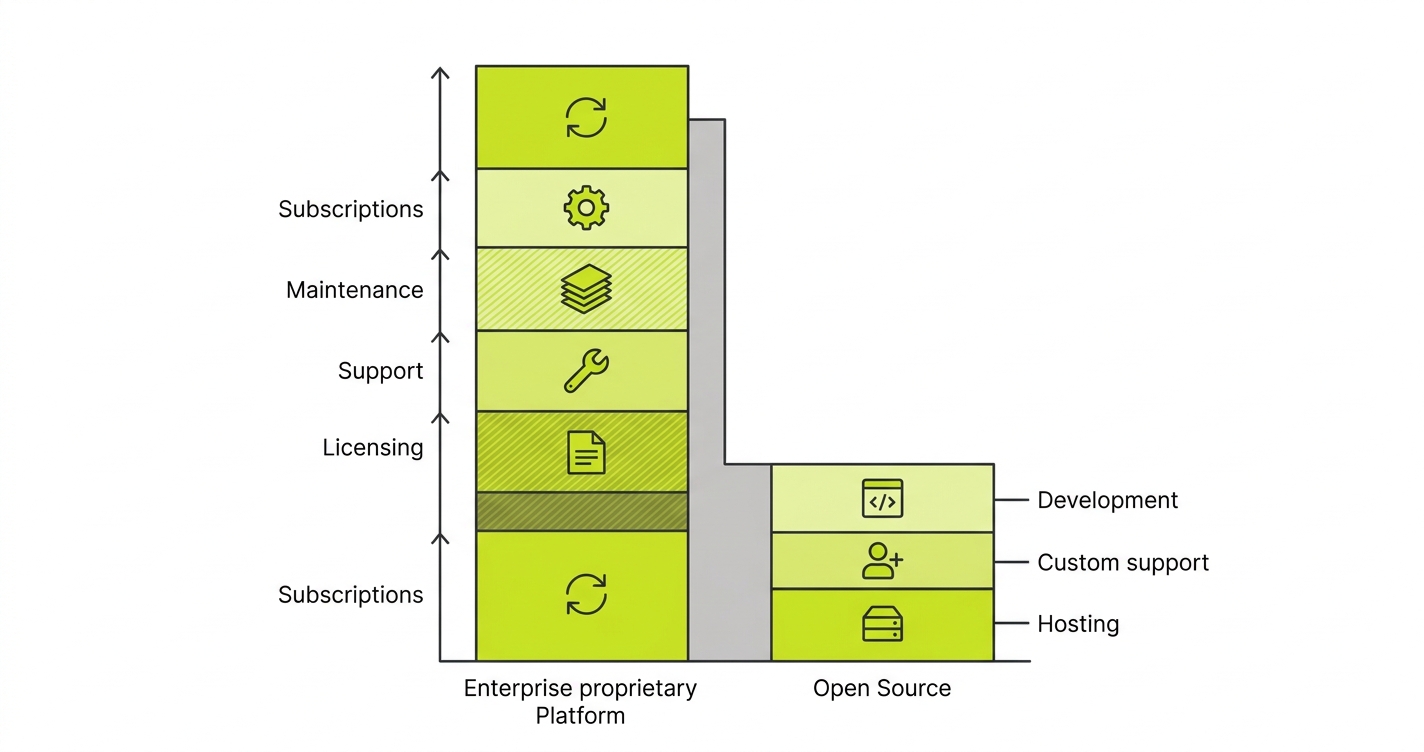
Autonoma cloud is $499/month ($18K over three years) with zero maintenance hours. AI self-healing handles UI changes automatically. That represents a 87-94% cost reduction.
Autonoma self-hosted eliminates the platform fee entirely. You pay only for the infrastructure you provision, typically $200-400/month depending on your parallel needs. Over three years, that totals roughly $11K: a 92-96% reduction compared to Sauce Labs' total cost of ownership.
The biggest savings is not the subscription difference. It is the elimination of both per-user pricing and test maintenance through AI automation. Sauce Labs charges you per seat to run tests you spend engineering hours maintaining. Autonoma charges a flat rate (or nothing for self-hosted) for tests the AI generates and maintains.
Migrating from Sauce Labs to Autonoma
Migration is simpler than you would expect because you are not rewriting Selenium tests line by line. Autonoma generates tests from your codebase. Most teams complete the process in 1-2 weeks.
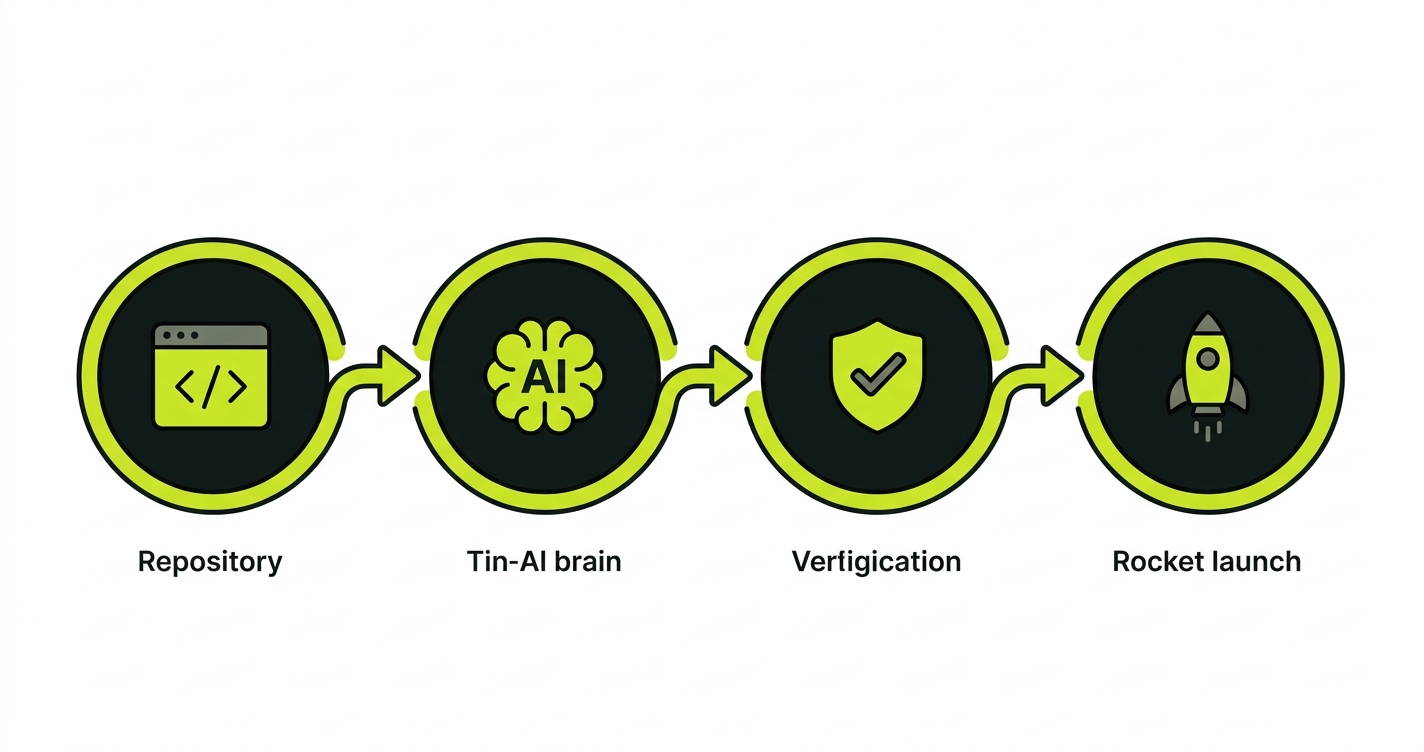
1. Connect your repo. Sign up for the free tier at getautonoma.com or self-host by cloning the GitHub repo and following the deployment docs. Connect your GitHub repository and let Autonoma's AI analyze your codebase (routes, components, and user flows). This takes minutes, not days.
2. AI generates tests. The test-planner-plugin builds a knowledge base of your application and generates comprehensive E2E test cases automatically. Start with 5-10 critical flows (checkout, authentication, core features) and run them in parallel with your existing Sauce Labs suite to compare results side by side. This gives you a direct comparison of reliability, execution speed, and coverage without risk.
3. Validate coverage. Compare AI-generated test coverage against your existing Selenium/Appium suite. Autonoma's vision-based tests are often more resilient than selector-based Sauce Labs tests because they understand intent, not DOM structure. Check for gaps, review the AI-generated test plans, and iterate. Most teams achieve full coverage within days because the AI generates tests from your actual codebase rather than requiring manual writing.
4. Update CI/CD and cut over. Point your CI/CD pipelines at Autonoma, train your team on reviewing AI-generated test plans, and cancel your Sauce Labs contract. If you are self-hosting, provision your infrastructure (ECS cluster, database, orchestration) during the validation phase so it is ready for the cutover. For teams on multi-year Sauce Labs contracts, run both platforms in parallel until the contract expires.
The key difference from a traditional migration: you are not rewriting 500 Selenium tests line by line. You connect your repo, the AI generates coverage, and you validate. The migration effort is about reviewing and verifying, not rebuilding.
Frequently Asked Questions
Yes. Autonoma is an open-source testing platform available on GitHub. Unlike Sauce Labs' proprietary closed-source model, Autonoma offers a free tier with 100K credits and full self-hosting capabilities. You can run Autonoma on your own infrastructure with no feature limitations, giving you better compliance auditability than Sauce Labs provides.
Yes. Autonoma is fully self-hostable with complete source code on GitHub. You can run it on your infrastructure (AWS, GCP, Azure, on-premise) with zero feature restrictions. Unlike Sauce Labs which offers SOC 2 and ISO 27001 certifications but no source code access, Autonoma lets compliance teams audit the actual testing infrastructure code.
Sauce Labs costs $149-249/user/month for standard plans, with enterprise pricing requiring custom contracts and separate SKUs for VDC, RDC, visual testing, and API testing. A 15-person team pays $27K-45K/year before engineering maintenance costs. Autonoma offers a free tier with 100K credits, cloud at $499/month flat (no per-user charges), and free self-hosting where you pay only infrastructure costs.
For many compliance requirements, yes. Sauce Labs holds SOC 2 and ISO 27001 certifications, but your auditors cannot inspect their source code. With Autonoma self-hosted, auditors can review every line of the testing platform code, verify data handling, and confirm that sensitive data never leaves your infrastructure. Full source code access provides deeper compliance assurance than vendor certifications alone.
Yes. You don't rewrite Selenium tests; you connect your repo and Autonoma's AI generates tests from your codebase automatically. Migration involves validating AI-generated coverage against your existing test suite. Most teams achieve full coverage within days. Unlike Sauce Labs where you write and maintain Selenium/Appium scripts, Autonoma's AI generates and maintains tests using vision models.
Sauce Labs is a proprietary enterprise cloud testing platform focused on compliance certifications and broad device coverage. Autonoma is an open-source AI-native testing platform that generates tests automatically from your codebase. Key differences: Autonoma offers source code access, self-hosting, AI test generation (no manual test writing), unlimited parallels, and no vendor lock-in. Sauce Labs offers broader device coverage and enterprise compliance certifications.
The Bottom Line
Sauce Labs is closed source, cloud-only, per-user priced, and locks your tests in proprietary Selenium/Appium configurations tied to their infrastructure. You write and maintain tests manually. The total cost (subscription plus maintenance engineering) runs $135K-$290K over three years for a mid-sized team. Their compliance certifications look impressive on paper, but they do not give your security team the one thing that actually matters: the ability to audit the code yourself.
Autonoma solves every one of those problems. Full source code on GitHub (BSL 1.1, Apache 2.0 in 2028). Self-host on your infrastructure for real compliance auditability, or use our cloud. AI generates and maintains tests from your codebase: zero manual writing, zero maintenance. Unlimited parallels on every plan. No vendor lock-in. No per-user pricing. Free tier starts at 100K credits, cloud at $499/month flat, self-hosted at infrastructure cost only. Three-year savings: 87-96% depending on deployment model.
Ready to try open source testing?
Start Free - 100K credits, no credit card, 5-minute setup
View on GitHub - Inspect source code, self-host documentation
Book Demo - See AI test generation in action
Related Reading:


